BOK to sharply lower economic growth outlook

Bank of Korea Governor Lee Ju-yeol speaks during the National Assembly Economy and Finance Committee in Yeouido, Seoul, Monday. Yonhap
Hong against 2nd round of cash relief to all
By Lee Kyung-min
Bank of Korea Governor Lee Ju-yeol said Monday that he cannot rule out the possibility of the economy contracting by more than 1 percent in 2020, due to the longer-than-feared continuation of COVID-19 infections.
This is far lower than the 0.2 percent projection made in May, based on the slow-but-steady decline of confirmed cases after a peak in the second quarter.
“The previous forecast will have to be significantly lowered,” Lee said at the National Assembly Economy and Finance Committee in Yeouido.
“Consumption will be considerably affected as new COVID-19 infections are recently showing signs of spreading, leading to stricter social distancing. We will need to take a closer look at the datasets.”
The gloomier-than-feared assessment follows a rapid jump in the daily number of new confirmed cases nationwide over the past week ― ranging between 197 (Aug. 16) at its lowest and 397 (Aug. 22) at its highest ― after reports of a mass infection among participants of street rallies and religious gatherings in downtown Seoul. The figure of new infections was 266 on Monday.
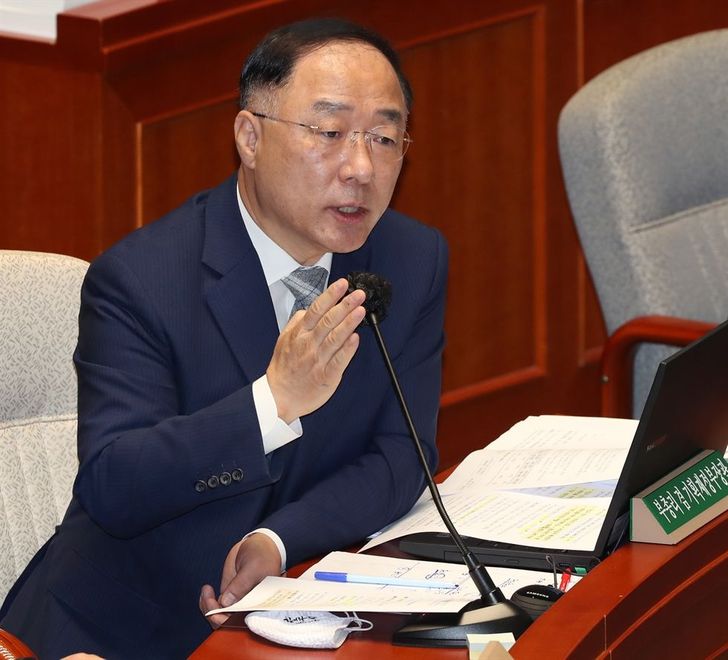
Deputy Prime Minister and Finance Minister Hong Nam-ki speaks during the National Assembly Special Budget Committee in Yeouido, Seoul, Monday. Yonhap
In a separate committee hearing, Deputy Prime Minister and Finance Minister Hong Nam-ki said that the government will not be able to offer an emergency relief similar to the previous one whereby up to 1 million won ($840) was given to all households, citing “improved” economic conditions.
If the government does push ahead with another round of cash-equivalent relief that required a 14 billion won supplementary budget, the recipients will be limited to those earning 50 percent or up to 70 percent of the median income, in a more efficient and tailored approach to help the most vulnerable, he added.
“It will be difficult for the second round of relief measures to take the exact same shape as the first one,” Hong said during the National Assembly Special Budget Committee.
“When the first cash relief was offered, we were facing a multitude of adverse economic conditions at once, but the economy is showing signs of recovery now, which makes the situation different from a few months earlier.”
The remarks came as a response to Rep. Kim Min-seok of the ruling Democratic Party of Korea who sought answers on the minister's view on the need for a greater stimulus package.
The finance minister said the cash-equivalent relief was effective, saying about a third of the assistance directly led to consumption.
Should the government seek a similar relief plan, it will have to rely entirely on issuing debt, an inevitable decision given about 10 of the 14 trillion won came from a painstaking budget reorganization, he said.
“The government has significantly reduced the planned expenditure in the course of drafting three extra budgets. With only four months left, further budget revisions will have only so much impact.”
Hong said disinfection and containment efforts should precede the need to bolster consumption and assist low-earners that experienced reduction or loss of income.
“The second relief package will have to be pursued with clear policy priorities including bolstering consumption and supporting those who have experienced income loss. For now, containment should come first.”