Reporter's notebook What is your identity? A question to FTC chief Joh Sung-wook
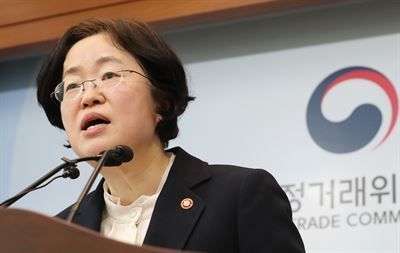
Joh Sung-wook / Korea Times file
Innovation initiative will be marred by questionable decision
By Lee Kyung-min
Innovation is a major policy drive of the Moon Jae-in administration.
The country’s 18 ministries as well as many other government agencies have made great efforts to come up with policies that fit the grand initiative, a collective agenda seeking sustainable, future-oriented growth, with the need all the more pronounced amid the economic crisis brought on by the COVID-19 pandemic.
Innovation is needed because the idea of something new can prompt people to reflect on the past and the present, leading to creative thinking for progress and improvement in the future.
It is therefore understandable for most ministries with the primary function of policy making to encourage new ways of thinking that could foster technological development.
But that is not the case with the Fair Trade Commission (FTC) whose first and foremost role as an antitrust agency is to crack down on unfair business practices.
FTC Chairwoman Joh Sung-wook came under heavy criticism in May for not filing a criminal complaint with the prosecution against Mirae Asset Financial Group and its founder and Global Investment Strategy Officer (GISO) Park Hyeon-joo over suspicions of the Park family gaining a profit of 43 billion won ($35 million) as a result of undue favors exchanged among group affiliates.
The group’s 12 affiliates paid 43 billion won to Blue Mountain Country Club, a golf club, and the Four Seasons Hotel between 2015 and 2017 for using the two facilities operated by Mirae Asset Consulting, the group’s core control body in which the Park family has a 91.86 percent stake.
The amount accounted for 23.7 percent of the two facilities’ entire revenue of 181.9 billion won in the cited period.
The antitrust agency clearly stated that an apparent “group-wide push was in place to draft a contract to defacto force the affiliates to use the facilities.”
It also said the shareholders of “Mirae Asset Consulting, or more directly the Park family, gained an undue profit in the form of robust growth of the firm’s hotel and golf club businesses.”
Despite the clear recognition of the group’s real estate investment subsidiary orchestrating the scheme to guarantee a stable source of revenue generation, the FTC fined the group a meager 4.39 billion won and gave Park only a verbal correctional order.
In what remains an explanation lacking any common sense, the FTC said, “A criminal complaint against Park was not warranted because his involvement was not that deep.
Park did not actively order the internal trading himself and only condoned it by keeping silent when he was briefed about it, which we thought was not that grave a violation of the law.”
The decision contrasts sharply with one against petrochemical and textile manufacturer, Taekwang Group, whose chairman, Lee Ho-jin, was referred to the prosecution over a similar suspicion alongside group Chief Strategy Officer Kim Ki-yoo and 19 affiliates. For over 14.1 billion won gained in undue profit, the group was fined 2.1 billion won.
Every time Joh has been asked about the controversial May decision since, she has repeatedly said the agency’s work should not be undercut by a single decision, stressing instead that its function should be more about innovation and creating an ecosystem to help foster businesses despite their size.
Yet clearly lacking in the remarks is an admission of and reflection on the far-reaching implications of the decision against the agency mandate to safeguard a fair competition spirit in the market economy.
The agency creating an innovative ecosystem is only as good as the principle of fairness upheld only by the faithful and full execution of its expected role.
Perhaps Joh needs to pause for a moment and ask what values she should put first as FTC head, mindful of the agency’s reason for its existence.
Otherwise, she will find herself losing respect due to a misplaced priority over what should have been be a distant, secondary initiative.