CEO watch Soft landing of accounting reform key task for Kim
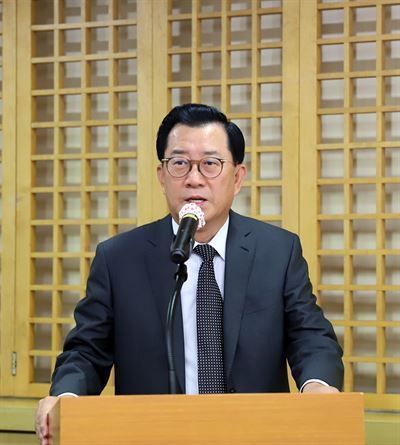
Kim Young-sik / Courtesy of Korean Institute of Certified Public Accounts
By Lee Kyung-min
Korean Institute of Certified Public Accounts (KICPA) President Kim Young-sik is expected to meet with as many representatives of businesses as possible over the next few months to help them fully embrace the newly enacted law under which private companies must pay higher fees to have their books audited by outside accounting firms.
The Samil PwC CEO was elected Wednesday to represent a group of 22,000 certified public accounts after garnering 4,638 of 11,624 votes, or 39.9 percent.
His top election pledge was to persuade businesses to embrace “accounting reform.” The pledge seeks to soft-land a related law that passed in 2017 and has since been implemented in stages. It requires private companies be audited by an accounting firm designated by the Securities and Futures Commission under the Financial Services Commission for a minimum of three years.
The new law helps accountants remain relatively free of the influence of firms under audit, as they have long held control over the “temporary hires.” This influence is the main reason many of them were afraid and reluctant to vocalize their opposition to what could later become an issue of corporate mismanagement.
The key to inducing his desired outcome will be to make businesses understand the need for and efficacy of embracing the revision, thereby making them willing to pay a much heftier fee than before.
An attempt at this was illustrated by his first official event where he is scheduled to meet the heads of the Korea Listed Companies' Association (KLCA) and the Federation of Middle Market Enterprise of Korea (FOMEK), the members of which maintain the accountant group is seeking to “steamroll” them into coughing up more money in the name of “reform.”
“We need to make businesses see that the auditing fee is not merely a costly business expense but necessary spending for high-value creation that will benefit both them and their investors,” Kim told The Korea Times.
Also on his list is to create a sense of unity among members in the group, long divided by the firms they work for. The years-long rift has recently been more pronounced between those at the so-called big four ― Samil PWC, EY, Deloitte Anjin and Samjong KPMG ― and the rest, as evidenced by candidate Chae Yi-bae representing the “underdogs” having garnered the second-most votes of 3,800, accounting for 32.6 percent of the total.
“The discord thus far has largely stemmed from fighting against one another with limited business opportunity. I will expand our market by increasing the size of the pie, and seek balance among members whether their source of contention be power, income or representation,” he said.
Born in 1957, the Korea University graduate joined Samil PwC in 1978 and became its CEO in 2016.