Korean New Deal feared to cause 'crowding-out effect'
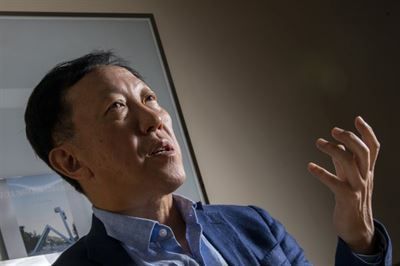
Lee In-ho, head of the Korea Economic Association / Korea Times photo by Shim Hyun-chul
By Lee Kyung-min
The government initiative to reinvigorate the country via the “Korean New Deal” will induce little to no desired outcome unless preceded by deregulation and measures to reduce labor market rigidity, a noted senior economist said Wednesday.
Voicing concerns over the possible “crowding-out effect,” he stressed that the government should not micromanage specifics involving corporate activities, but focus on removing administrative inefficiencies, thereby letting the private sector lead the debate and reach a conclusion on how best to allocate resources and make key management choices unaffected by costly red tape.
The “crowding-out effect” refers to a phenomenon under which increased government involvement discourages private sector investment and spending.
“The government should stop overstepping its bounds,” said Lee In-ho, a Seoul National University economics professor who heads the Korea Economic Association.
State intervention is only as good as the business environment created to maximize corporate profit without undercutting public good. Yet policymakers refuse to acknowledge their lack of inefficiency concerns, trying to control firms by issuing directives whose inflexibility gets in the way of reducing costs, he explained.
The remarks came after the Ministry of Economy and Finance said June 1 that it would invest 76 trillion won ($61.9 billion) by 2025 to strengthen digitization, eco-friendly growth and the social safety net, in a sweeping move to reinvigorate the economy hit by the COVID-19 pandemic.
“The recently announced Korean New Deal has nothing new. Crucial measures involving deregulation are nowhere to be found and most policies are about offering tax incentives that are insufficient to alter corporate plans. From a business standpoint, firms have no reason to welcome what is supposed to be a grand new plan,” he said.
He added the crowding-out effect will materialize because the original series of policies that made up the U.S. New Deal of the 1930s had two labor-friendly policies including wage hikes and delayed sanctioning of antitrust activities, enabled by National Industry Recovery Act (NIRA) and National Labor Relations Act (NLRA). The two acts contain clauses capping working hours and increasing minimum wage ― the two thorniest issues debated in Korea.
“The pro-labor, cartel-condoning policies included in the U.S. New Deal led to prices of goods rising over 23 percent and wages increasing 25 percent for the following three years after the initiative was put in place, leading to a reduction in corporate investment prolonging economic downturn for years. The government should be mindful of the policy implications and shortcomings of the U.S. measure rather than seeking to emulate a superficial idea,” he said.
The economic stimulus package in the near term, he stressed, should focus on salvaging otherwise robust firms, and helping those whose income has been substantially reduced or downright removed.
“Having prices of consumer goods and wages under control is a vital tool for a speedy economic recovery. Increasing them will delay recovery, resulting in heavier prices to pay due to elevated risks being prolonged,” he said.