Is Hong Kong's era as financial hub coming to end?

Protesters carrying umbrellas march during a rally against the implementation of a new national security law in Causeway Bay, Hong Kong, May 24. Beijing unveiled a resolution at the opening of its annual legislative sessions that will bypass Hong Kong's legislature to outlaw acts of secession, subversion and terrorism in Hong Kong. / EPA-Yonhap
Seoul needs to fix regulations to become attractive
By Kim Bo-eun
Hong Kong is losing its luster as Asia's premier financial hub, with the U.S. moving to remove its special status as autonomous from China.
This follows China's promulgation of a national security law that casts a negative light on prospects for the city, as it is seen as a move by Beijing to integrate the territory into the mainland
The developments come after a year of instability in Hong Kong fueled by protests against China's tightening grip over its administration.
U.S. Secretary of State Mike Pompeo declared, May 27, that Hong Kong was no longer autonomous from China, amid renewed trade tension between the world's two largest economies. Specific measures have yet to be taken, but this means that Hong Kong may become subject to tariffs imposed on China that it was previously exempt from.
Pompeo's remarks came after China's “rubber stamp” parliament stated it would introduce a national security law to ban the “secession” of Hong Kong. Foreign businesses worry that regulators and courts in the territory will lose their independence as a result of this move.
The situation casts uncertainty on the prospects of the financial hub, with a growing amount of money leaving Hong Kong for other cities and some financial firms reducing their operations there.
Singapore is seemingly benefitting from the instability as the city state has seen record foreign fund inflows, with most coming from Hong Kong.
According to the Monetary Authority of Singapore, foreign currency deposits at banks in Singapore increased 29 percent to a record 27 billion Singapore dollars ($19.4 billion) in April from the same month last year. Banks also saw record high non-resident deposits ― up 44 percent to 62 billion Singapore dollars over the same period.
In addition, Australian investment bank Macquarie and Japanese securities firm Nomura are scaling down their operations in Hong Kong, according to recent media reports
Prospects
"Hong Kong could lose the most favored nation status in trading with the U.S. President Donald Trump could issue an executive order or the U.S. Congress could repeal the existing law," Sohn Sung-won, a professor of economics at Loyola Marymount University, said. Sohn was a senior economist at the White House during the Richard Nixon administration.
"Korean firms will have to wean themselves away from China and Hong Kong, as large trading nations including the U.S., Europe and Japan will reduce their dependence on supply chains related to China and Hong Kong,” he said.
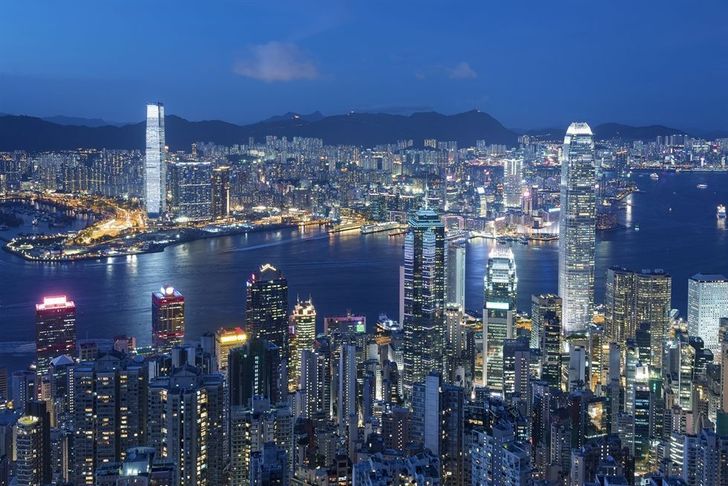
An aerial nightscape of Hong Kong / gettyimagesbank
Mauro Guillen, a professor of international management at the University of Pennsylvania's Wharton School, said, "The U.S. administration is trying to put pressure on China on many fronts, to obtain trade and intellectual property concessions. This move on Hong Kong is part of it.”
"Removing Hong Kong's trade status is already damaging. Imposing financial restrictions would be really problematic for the territory."
Regarding China's national security law, Andy Xie, an independent economist based in Shanghai, said, “So far, Beijing says it wants only to handle security and political issues with the new law. So it still wants to keep the economy side the same as before.”
But at the same time, the former Morgan Stanley Asia-Pacific chief economist noted, “We don't know if some of the economic issues would fall into the security or political bucket.”
Rise of Singapore?
Singapore overtook Hong Kong in the U.S. Heritage Foundation's Index of Economic Freedom this year. Hong Kong had topped the index since it was first published in 1995.
Experts agreed Hong has been losing its attractiveness as a financial hub for some time.
"Hong Kong's status as a center for doing business and as a financial hub has been deteriorating for at least a decade, to the benefit of Shanghai and Singapore," Guillen said.
Sohn added, "Foreign financial firms have been moving to Shanghai for some time. It is most likely Hong Kong will continue to lose its luster as a financial center. Singapore is the most likely candidate." He said the use of Mandarin in Singapore is favored by mainland Chinese.
Antonio Fatas, a professor of economics at INSEAD, said Hong Kong would remain a strategic location for foreign firms.
"Yes, some more western-oriented firms might move, but a presence in China will remain crucial for some companies. Even if Hong Kong integrates faster into the Chinese system, it might remain attractive," he said.
At the same time, he noted, "Singapore is and will remain the strongest competitor."
What it takes to be financial center
Major cities in Asia are eyeing the opportunity arising from recent developments. But experts point out that Seoul still has too many regulations to make it attractive as a financial hub.
"Even before China became a powerhouse in global trade, Hong Kong was an even bigger financial center than it is," Sohn said. "The biggest reason was the free market philosophy and no taxes. Korea still has too many financial regulations and taxes."
Fatas said Seoul and Tokyo could be attractive, but may lack scale, explaining why firms tend to go to New York or London.
"Attracting talent, the right regulations and integration with other markets are all necessary ingredients," Fatas said.
"If Seoul wants to play this game it will be a long race for it to attract the activity of any of the current financial centers around the world.”