KOSPI's price-earnings ratio hits highest level in 10 years
By Anna J. Park
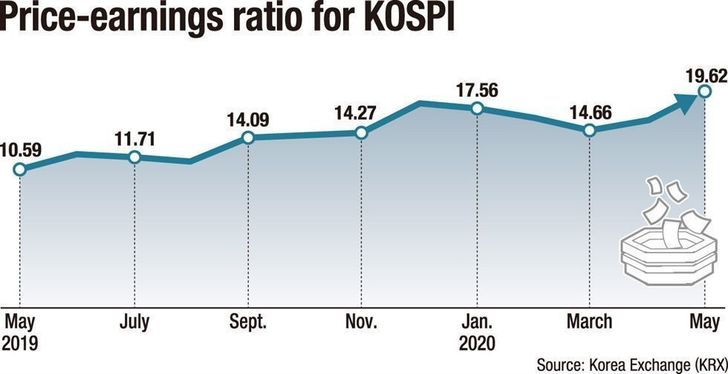
Concern has been raised as to whether the KOSPI is overvalued, as shown in the record-high rise in the price-earnings ratio (PER) level over a decade.
According to the Korea Exchange (KRX), the benchmark index' PER, as of May 27, logged 19.6, which is the highest since April 2010, when the figure exceeded 20. The PER is the ratio of a company's stock price to the company's earnings per share, and functions as a barometer over whether the share prices are overvalued or undervalued.
The PER fell to 12.1 in mid-March as the COVID-19 outbreak spread nationwide, but soared to 19.6 in just a couple of months, along with the recent rebound in stock prices. The KOSPI rose 39 percent during the period.
Experts say high PERs are fine and pose no problem as long as they are a reflection of a companies' performance estimate for the near future.
“The current level of valuation of the KOSPI is not that burdensome, as profit estimates are also increasing,” said Kim Joong-won, an analyst at Hyundai Motor Securities. “It is estimated that the current market is focusing on major countries' turnaround in their real economies and accompanied potential export improvement,” he added.
Some market observers also still think the excess of liquidity in the market would continue to buttress stock prices, as investors find no place else to put their money amid zero-percent range interest rates.
However, another group of market watchers express concerns that corporate performances could deteriorate as the local economy is expected to contract this year, for the first time in 22 years; while the global economy is also expected to contract by 3 percent, according to the IMF.
“In order for the stock market to continue its bullish trend, investors need to favorably anticipate next year's corporate performance; it all depends on the recovery speed of the global economy,” Oh Tae-dong, an analyst at NH Investment & Securities, said.