Gov't to ease rules for local breweries
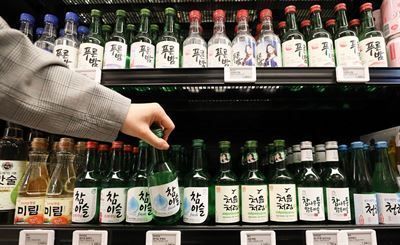
A customer picks up a bottle of soju at a shop in Seoul, April 28. / Korea Times file
By Lee Kyung-min
The government said Tuesday that it will make significant revisions to the law governing the manufacturing, sales and distribution of alcoholic beverages, in a move to help level the playing field for domestic businesses that are increasingly dwarfed by the rapid growth of the imported alcoholic beverage market over the past few years.
The Ministry of Economy and Finance said local breweries will be able to save time and money via simplified regulations, eased rules on licensing and streamlined tax filing.
“We believe the revisions will help remove overall inefficiencies, thereby helping local breweries gain a competitive edge against imported ones. Related industries are also expected to benefit,” a ministry official said.
The measure came amid steady decline in sales by domestic breweries over the past few years, an inevitable result of what they consider a “loophole” long exploited by their foreign counterparts that are not subject to the same heavy tax and “growth-stunting” regulations. Domestic producers claim imported products sell cheaper and are more accessible to consumers.
The ministry's collected data showed domestic breweries reported a 2.5 percent year-on-year decrease in sales between 2014 and 2018, while imported alcoholic beverage market grew 24.4 percent year on year in the same period.

Economy and Finance Ministry Deputy Minister for Tax and Customs Lim Jae-hyeon, center, speaks during a press briefing at Sejong Government Complex, April 18. Courtesy of Ministry of Economy and Finance
Under the revision, small local breweries will be able to share manufacturing facilities run by their large peers or non-alcoholic beverage producers, which the ministry says will help small firms without enough capital run their business.
Breweries will not need approval every time they make new products, increase or decrease alcohol content or add new ingredients.
The ministry will no longer require manufacturers to put stickers on the beverage container stating where they are to be sold, given the costly process is unnecessary when the content is the same.
Producers of traditional liquor ― mostly makgeolli, a rice-based fermented alcoholic beverage ― and beers will not be required to provide documents that prove related tax has been paid, a requirement that has long been criticized as unnecessary.
Foreigners who visit Korean traditional breweries will be able to buy makgeolli there tax free, which the ministry says will help boost tourism demand from overseas travelers.
The government said customers who make online orders for alcoholic beverage delivery along with food can do so only if the beverage is cheaper than the food.
This was to clarify an ambiguous clause in a related law used by some customers who tried to order boxes of alcoholic beverages while ordering a single serving of food.
The revisions will be submitted to the National Assembly soon.