Top-band earners spend four times more than bottom-band
By Lee Kyung-min
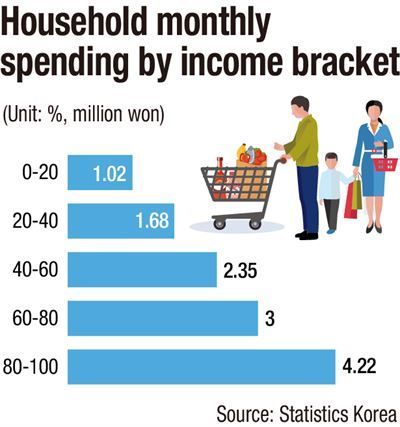
Where spending is spread across 5 tiers, the monthly household spending of the top-band of earners was four times greater than that of the bottom band in 2019, government data showed Thursday. The figures exclude spending on taxes, interest payments and monthly premiums for state-run healthcare and national pension services.
According to Statistics Korea, those in the top band spent 4.22 million won ($3,400) a month, whereas those whose earnings are in the bottom band spent 1.02 million won.
Those in the second-highest income brand spent 3 million won, followed by 2.35 million won spent by those in the middle band and 1.69 million won by those in the second-lowest band.
For the bottom band, nearly a fifth, or 19.9 percent of spending was on food and non-alcoholic beverages followed by housing and utilities (19.5 percent), healthcare (12.9 percent) transport (7.3 percent) entertainment and cultural activities (5.3 percent) and education (2.1 percent).
The top band spent 12.8 percent on transport (12.8 percent), followed by education (11.9), food and non-alcoholic beverages (11.2 percent), entertainment and cultural activities (9.1 percent), housing and utilities (7.8 percent) and healthcare (7.1 percent).
The spending disparity was the widest in education with the top 20 percent spending an average of 504,000 won, about 20 times the 22,000 won spent by the bottom 20 percent.
The monthly spending of all households nationwide averaged 2.45 million, down 3.2 percent from 2.53 million won a year earlier.
On average, some 14.1 percent, or 346,000 won, was spent on food, followed by non-alcoholic beverages (13.5 percent), transport (12 percent) and housing and utilities (11.3 percent).
Single-person households spent an average of 1.42 million a month, while four-person households spent 3.71 million won.
Single-person households spent the most on housing and utilities which accounted for 17.9 percent of the total, whereas education topped the spending list for four-person households accounting for 15.8 percent of the total.
A family of at least three composed of two parents with at least one child spent almost 1 million won more than a family of two spouses without any children, with the former's spending averaging 3.52 million won and the latter 2.59 million won.
Those with children spent 12 percent of their income on education, while the same expense accounted for 2.3 percent for those without children.