PEFs still stigmatized as greedy vultures

gettyimagesbank
Unions, civic groups protest against buyout funds
By Park Jae-hyuk
Domestic private equity firms (PEFs) are still suffering from the prejudice that they are “greedy vultures,” although it has been 15 years since Korea allowed their operation and they have become key players in the local M&A market.
Their investment strategies are still considered negative by the public, who remember when Lone Star Funds raked in huge profits from its investment in the Korea Exchange Bank (KEB) just after the 1998 Asian financial crisis.
The American PEF, which bought a 51 percent stake in KEB for 1.3 trillion won ($1 billion) in 2003, resold the bank to Hana Financial Group for 4 trillion won in 2012, after it failed to resell KEB to HSBC due to the opposition of financial authorities here.
Since then, PEFs have been regarded as speculators focusing only on short-term gains.
During the recent bidding for Prudential Life Insurance Company of Korea, consumer groups opposed the life insurer being sold to PEFs ― MBK Partners, Hahn & Company and IMM Private Equity.
“Benefits that are supposed to be paid to beneficiaries are coming from insurance companies' assets, and the assets are necessary for at-risk policyholders to continue with their lives,” said Bae Hong in charge of monitoring the insurance industry at the Korea Finance Consumer Federation. “PEFs that pursue short-term profits should be banned from acquiring insurance companies.”
Protests from unions have been much more intense than those from consumers.
Whenever PEFs take over businesses, their unions have held rallies.
Until Prudential sold its Korean operation to KB Financial Group in April, the union of Homeplus owned by MBK had held rallies in front of the headquarters building of the U.S. life insurer's local subsidiary.
When VIG Partners said April 10 it had acquired Preedlife, the leading funeral service provider here, the union of funeral service workers released a statement to protest the decision.
“A PEF's acquisition of a large funeral service provider could cause massive damage to consumers,” union leader Lee Sang-jae said in the statement. “PEFs aim to buy undervalued companies and resell them after raising their enterprise value, but they are not interested in improving the long-term value of companies they acquire.”
The union called for thorough supervision by the government to restore trust in the funeral service industry and sound management.
KL & Partners is also facing difficulties in stabilizing Haimarrow Food Service, the operator of Mom's Touch fast food franchise, after acquiring it recently.
On April 21, the Haimarrow union referred managers from the PEF to the Seoul Regional Employment and Labor Administration, alleging they violated the Labor Law.
According to the union, the management attempted to incapacitate it by monitoring union leaders through CCTVs and laying off employees who complained about the management. The union also claimed the management deprived one union leader of his employee ID card.
The management denied the union's claim.
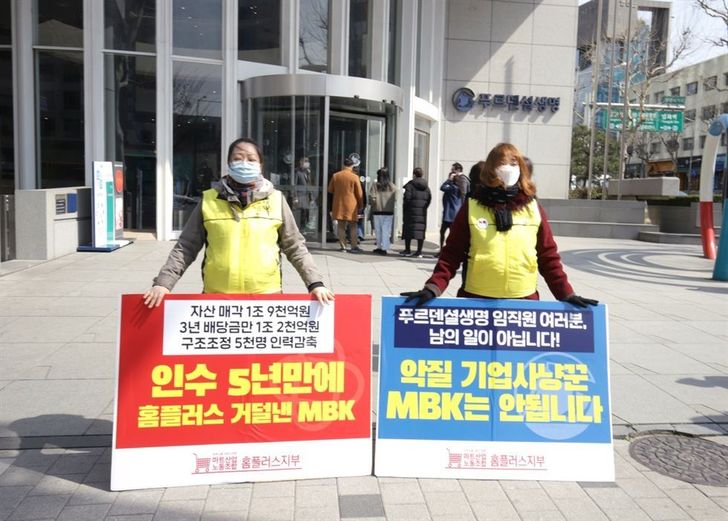
Homeplus union members hold a rally in front of the Prudential Life Insurance Company of Korea headquarters in Seoul, March 13, to protest an attempt by MBK Partners, the Homeplus owner, to take over the U.S. life insurer's Korean unit. / Courtesy of Homeplus union
Advantage of PEFs
Industry experts have been concerned that negative sentiments toward PEFs may prompt the financial authorities to tighten regulations and bar them from playing a role in improving enterprise value.
Unison Capital partner Kim Soo-min said at a symposium at the Korea Federation of Banks headquarters in Seoul in November last year that current regulations discriminate against Korean general partners and were in favor of their foreign counterparts that are free of local regulations.
He also said PEFs involved in the management of mid-size companies have improved their enterprise value and created jobs, so that they grow into large companies.
According to the Korea Capital Market Institute, revenues at 90 companies in which PEFs invested between 2005 and 2014 rose to 230 billion won each on average when they were resold, from 147 billion won on average when they were acquired by the PEFs.
The think tank said the number of employees rose to 443 on average from 423.
According to Shinhan Investment, stock prices of companies sold to PEFs after 2009 also rose by an average 65.5 percent, four years after the PEFs started managing them.