Is Korea's housing market heading toward long-term slump?

Experts split over future course of real estate market
By Lee Kyung-min
Property prices are likely to stagnate for the time being, mostly due to the COVID-19 pandemic but compounded by weakening investment sentiment on fears of stricter lending rules and heavier taxes on multiple home owners, a key policy drive set to become tighter following the overwhelming general election victory of the ruling party, experts said Tuesday.
Some believe the recently sliding prices following years of rapid hikes will continue on a downtrend, saying prices could fall even faster upon the arrival of key economic indicators and data points confirming virus-sparked shocks in the real economy.
Yet, others say the drop will be limited given low interest rates, supply shortages and the rising price of Jeonse deposits compared to the market value of apartments, an indication of a further drop in apartment prices in the coming months.
Unique to Korea, Jeonse is a way of renting a home whereby tenants pay a lump sum as a deposit instead of monthly rent.
Data from KB Kookmin Bank showed the apartment trading price index for Seoul stood at 86 in April, down from 99.2 a month earlier. Based on a survey of 4,000 realtors, the index measures market sentiment on a scale of 0 to 200. A below-100 reading means pessimists outnumber optimists.
The below-100 reading shown for the second consecutive month shows the continuation of the weak sentiment that began in March when apartment prices in Seoul dropped for the first time in ten months, breaking the uptrend that had continued since June 2019.
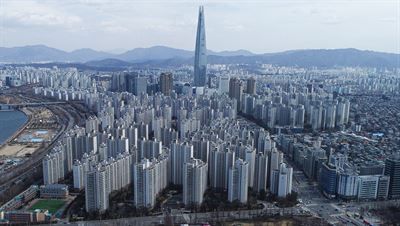
An apartment complex in southern Seoul / Korea Times file
Korea Development Institute (KDI) Strategy of Economic Policy Director Song In-ho said prices will face strong downward pressure amid the onset of “shocking” figures reflective of the magnitude of the crisis brought on by the novel coronavirus outbreak.
“The market could be sent into a tailspin,” he said.
The current, slight adjustments in price in his view will take a dive as soon as the idea of an inevitable recession sinks in with market participants, with the trigger being economic indicators for growth, exports and employment.
The damage to the real economy and subsequent shared pessimism will then translate into a rapid loss of confidence in the real estate market, a much-feared beginning of a vicious cycle hitting the market and the livelihoods of those in it.
Once the market tanks, the recovery will not come nearly fast enough to make up for the losses, which he says is the result of the “lower resiliency” of the real estate market compared to, for example, the equity market which is defined by its highly volatile nature.
“The real estate market unlike those involving highly liquid asset classes will suffer for up to three years. Given the policy direction of the Moon Jae-in administration on stronger measures to curb the housing market, home prices will drop in Seoul and the surrounding Gyeonggi area. The only upside at this point is that the spread of the coronavirus could end earlier than expected, helping normalize economic activities.”
But a market recovery could come earlier than expected with a limited possibility of the current price drop developing into a full-blown tumble, according to a different expert.
The optimistic view is based on a clear absence of trading activities in auctions where those on the brink of economic collapse are pushed to put their houses up for sale.
“Panic in the market is defined by a large number of home owners putting their homes up for sale after they are unable to make debt payments due to tightening financial conditions, and that is not happening now. The price will not take a major tumble any further and could recover as soon as the virus spread is brought under control,” Construction Economy Research Institute of Korea (CERIK) senior research fellow Doo Sung-kyu said.