Services industry output suffers biggest setback amid pandemic
Business sentiment falls to 11-year low
By Lee Kyung-min
The nation's services industry output suffered its biggest monthly drop in March due to the fallout of the COVID-19 pandemic amid falling business confidence, data showed Wednesday.
This has raised concerns that the twin engines of the Korean economy ― domestic demand and exports ― are losing steam, pushing the country into a deep recession. Given that lockdown measures abroad are not factored in yet, things are likely to further deteriorate down the road
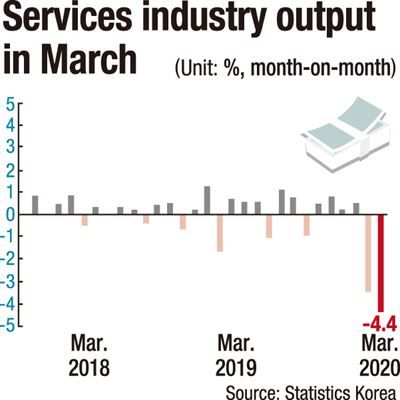
Statistics Korea data showed that services industry output dropped 4.4 percent in March from a month earlier, the biggest monthly decrease since the agency began compiling related data in 2000.
This was due mostly to social distancing, a guidance to prevent the further spread of COVID-19 that has tanked the lodgings, tourism and entertainment businesses.
The services sector drop led to a 0.3 percent decline in overall industrial output, despite production increases in manufacturing, energy, public administration and construction.
On a month-on-month basis, entertainment, leisure and sports reported the steepest decline of 31.2 percent, followed by lodgings and restaurants (17.7 percent), storage and transport (9 percent), education (6.9 percent), and wholesale and retail (3.3 percent).
“The services industry output fell 4.4 percent in March following a 3.5 percent decrease in February. A second consecutive monthly decline in the sector suggests that this crisis is a services industry-centered crisis,” First Vice Finance Minister Kim Yong-beom said Wednesday.
The damages are more pronounced when measured by year-on-year figures. The output of the entertainment, leisure and sports sectors was nearly halved with a 45.9 percent drop from 2019. This was followed by lodgings and restaurants (32.1 percent), storage and transport (16.4 percent), education (9.6 percent) and wholesale and retail (6.7 percent).
Consumption reported a 1 percent month-on-month drop in March, as a 14.7 percent increase of automobile sales failed to offset reduced demand for semi-durable goods such as clothes, and non-durable goods including cosmetics.
About 37.3 trillion won ($30.6 billion) in consumption was reported in March, down 7.1 percent from a year earlier, a much steeper drop from the 0.5 percent decline reported in February.
The March figure was driven by a 49.8 percent drop in sales experienced by duty free shops, followed by department stores (36.8 percent), retail stores (25.3 percent) and wholesale malls (6.7 percent).
Investment increased 7.9 percent from a month earlier, led by spending on industrial equipment (8.1 percent) and transport equipment (7.2 percent).
The economic coincident indicator, measured by its cyclical component, stood at 98.6 in February, down 1.2 points from a month earlier, the steepest fall since December 2008. This is a broad-based measurement of current economic conditions.
The economic leading indicator, a measurement of future economic conditions, came to 99.6, down 0.6 points from the month before, the lowest since February 2008.
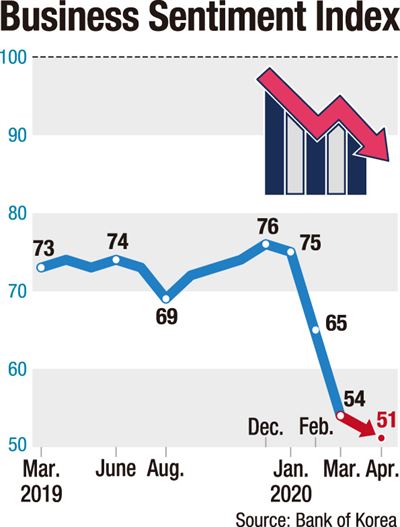
Indicative of a further slump is business sentiment that fell for the fourth consecutive month.
According to the Bank of Korea, Wednesday, its overall business sentiment index fell further to 51 in April from the previous month's 54. It was the lowest figure in over 11 years since it recorded the same number in December 2008.
Korea Development Institute Macroeconomic Analysis and Forecasting Director Jung Kyu-chul expects that numbers will become much uglier in the coming months.
“Figures will be much worse from April and thereafter given the March data have yet to reflect Korea's exports to the U.S. and Europe, both of which are still reeling from the virus spread,” he said.
“Also feared to decline is investment closely linked to exports, putting a major dent in the economy that is already under heavy strain,” he added.