Young jobseekers bearing brunt of COVID-19
By Lee Kyung-min
College graduates are bearing the brunt of the COVID-19 pandemic as many firms are implementing a hiring freeze due to a nosedive in corporate profit, data showed Wednesday.
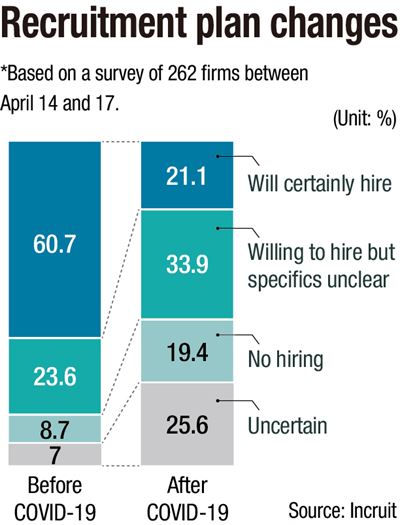
According to a survey conducted by Incruit, a job search site, nearly half of the surveyed firms said they had no recruitment plan scheduled or are uncertain whether they would hire new workers after the coronavirus pandemic.
The same response was given by around 15 percent before the virus outbreak.
In a survey of 262 firms between April 14 and 17, those who responded that they would certainly hire new employees dropped to 21.1 percent, about a third of the 60.7 percent willing to hire before the pandemic.
Firms that said they had no hiring plans accounted for only 8.7 percent before the pandemic, but the number has since jumped to 19.4 percent.
The firms had planned to hire a combined 12,919 new workers in 2020, but the number dropped by 44 percent to 7,274.
The hiring period is scheduled for September or later this year, meaning the number of those landing jobs could shrink further depending on further negative market developments.
The grim outlook comes shortly after a state think tank study showed Korea could lose 333,000 jobs this year.
According to a report written by Pusan University Economics professor Kim Hyun-sok commissioned by Korea Economic Research Institute (KERI), 333,000 people could lose their job due to COVID-19.
His projection was premised on forecasts that the Korean economy would contract at least 4.89 percent or up to 6.7 percent this year, in line with previous economic forecasts made by the World Bank and global investment banks and research institutes.
In that scenario, at least 182,000 and up to 333,000 people would lose jobs, which will be the worst since 1998's Asian financial crisis.
Kim took into account that Korea is a small, open economy highly vulnerable to external shocks, and that the real economy already began to falter long before the pandemic due to the U.S.-China trade feud.
But with the more “hopeful” expected average of 1.35 percent contraction applied, the number will be limited to around 50,000 or up to 67,000.
To prevent the worst case scenario, the KERI submitted a recommendation with the Ministry of Employment and Labor on various ways to help both employees and employers weather the crisis as well as halting the hike of the hourly minimum wage.
Included in the recommendations is allowing small and medium-sized firms with robust financials to take out government-backed loans with less than 2 percent interest if the purpose is to pay workers.
The KERI also recommended that those placed on unpaid leave be made eligible to receive unemployment benefits for three months after the date of the leave began.