195,000 jobs vanish: Pandemic starts to suffocate job market

Korea suffers first job loss since 2009 financial crisis
By Park Jae-hyuk
The COVID-19 pandemic's impact on the domestic job market has come to the fore.
Data from Statistics Korea showed Friday that the number of employed people stood at 26.6 million in March, down 195,000 from the same month a year earlier
This was the first year-on-year decline since January 2010 and the sharpest decrease since May 2009, when the world was suffering difficulties from the Global Financial Crisis.
The number of temporary layoffs ― categorized as employed in the statistics ― hit a record-high of 1.6 million in March, up 1.26 million from a year earlier, as domestic air carriers, travel agencies and duty free shops have imposed out massive unpaid leave during the pandemic.
Although temporarily laid-off workers tend to return to their workplaces, they could become unemployed or economically inactive if the situation worsens.
The statistics agency said the number of economically inactive people reached 16.9 million in March, a 516,000 year-on-year increase.
Among them, the number of people who gave up on getting jobs was 582,000, up 44,000.
The number of those who had no plan to look for jobs ― regarded as de facto jobless ― also reached a record-high of 2.36 million, a 366,000 increase from the previous year.
According to the Ministry of Economy and Finance, the decline in the number of employed people was especially significant in the services industry which lost 294,000 jobs ― the steepest since September 1998, when Korea was hit by the Asian Financial Crisis.
“Affected by the falling number of foreign tourists and social distancing, the number of people employed in lodgings, restaurants, and wholesale and retail businesses dropped sharply,” the finance ministry said in a press release.
“The delayed school opening and cram school shutdowns sharpened the decrease in the number of employees in the educational services sector.”
The number of those employed in the manufacturing industry also dropped after a temporary increase in January and February.
The construction sector has continued a downward trend because of falling housing demand.
By status, the numbers of temporary and daily workers diminished by 420,000 and 173,000, respectively.
The number of the self-employed who hired staff declined by 195,000, while the number of those who did not hire staff jumped by 124,000.
Although the number of the unemployed dropped 17,000 year-on-year to 1.18 million in March, the finance ministry attributed this to the slow labor supply caused by postponement of recruitment amid growing concerns over the pandemic.
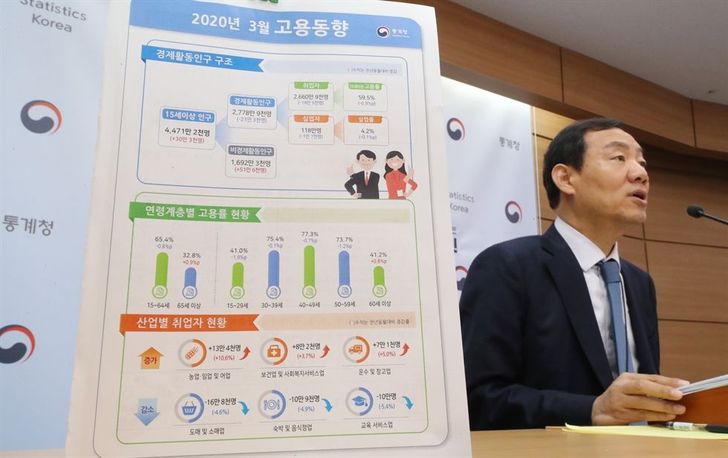
Statistics Korea director-general Eun Sun-hyun announces the monthly job market trend in March at the Government Complex Sejong, Friday. / Yonhap
Considering the increasing corporate bankruptcies here and the global labor market collapse, the job crisis is expected to worsen.
Supreme Court data submitted to Rep. Chae Yi-bai of the minor opposition Party for People's Livelihoods showed 101 corporations nationwide applied for bankruptcy in March, up 53 percent from a year earlier.
Meanwhile, in the United States, 22 million people have filed jobless claims over the past four weeks, according to the country's Department of Labor.
Against this backdrop, economic experts called for additional government measures to cushion the coronavirus impact on the job market.
“If the government refuses to give enough financial support to liquidity-crunched businesses, temporarily laid-off workers will eventually lose their jobs permanently, having a negative impact on the entire economy,” Yonsei University economics professor Sung Tae-yoon said.
In response, Deputy Prime Minister and Finance Minister Hong Nam-ki said the government will announce measures to stabilize the job market early next week.