Landslide victory legitimizes President's economic policies

President Moon Jae-in, third from left, and Finance Minister Hong Nam-ki, second from left, enter a meeting room in Cheong Wa Dae, March 18, to attend a meeting convened to discuss measures to contain the COVID-19 pandemic. / Korea Times photo by Wang Tae-seok
Elected financial industry experts vow deregulations
By Park Jae-hyuk
The landslide victory of the ruling Democratic Party of Korea (DPK) in Wednesday's general election will give an impetus to President Moon Jae-in's key economic policies, such as income-led growth, fiscal expansion and control over chaebol, according to economic experts, Thursday.
Amid growing concerns over the COVID-19 pandemic's impact on the economy, the experts said the government will keep trying to play a bigger role after garnering nationwide support.
“The government will enhance its expansionary fiscal policies and stimulus measures to prevent sluggish exports from affecting domestic demand,” Eugene Investment & Securities analyst Lee Sang-jae said.
Having hosted a series of Emergency Economic Council meetings to come up with measures for immediate implementation to cushion the coronavirus impact, the Moon government has delivered large-scale stimulus measures, including 100 trillion won ($81 billion) in emergency funding for virus-hit businesses and disaster relief money for households in the lower 70 percent income bracket.
Against this backdrop, the DPK has hinted it may seek a third supplementary budget for this year.
This will likely be discussed in the 21st National Assembly and is expected to earn widespread support, considering the ruling party's sweeping victory.
Regarding income-led growth, Lee said the government will also keep pushing forward with this policy.
“It is difficult to judge within a couple of years whether or not the income-led growth policy has generated a meaningful outcome, so at this moment, it is difficult to expect the government to abandon it,” he said.
Seoul National University economics professor Lee Phil-sang shared this view, saying it is highly probable that the government will continue to pursue fiscal expansion and income-led growth.
He also expects the administration will continue with regulatory measures on conglomerates.
“Economic fairness is one of the government's basic philosophies,” the professor said.
“In this regard, regulations on businesses are unlikely to be eased. The government is likely to maintain or tighten regulations regarding fair trade and the environment.”
Having predicted the ruling party's victory in a report published a few months before the general election, CLSA head of Korea research Paul Choi said in the report that the outcome would increase state control of the economy and would allow the administration to continue regulating businesses, increase taxes and maintain labor-friendly policies, which he called “socialist policies.”
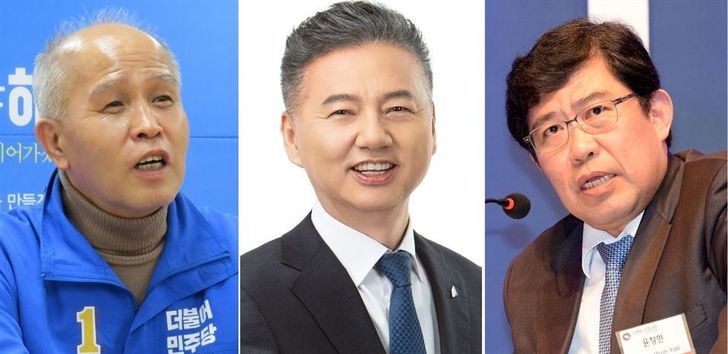
From left, Lee Yong-woo and Hong Sung-guk of the ruling Democratic Party of Korea, and Yun Chang-hyun of the Future Korea Party / Korea Times file
Innovative growth
In contrast with its regulations on conglomerates, the government is expected to seek innovation for small- and medium-sized enterprises (SMEs) and the financial industry.
Having come up with “innovative growth” as one of its major economic pledges, the ruling party has vowed to ease regulations on new industries and to foster 300 SMEs engaged in manufacturing materials, components and equipment over the next five years.
In addition, it promised to supply 30,000 smart factories to small- and medium-sized manufacturers by 2022.
“Since the ruling party won the election, the Moon government needs to introduce more drastic deregulatory measures to boost the economy,” Professor Lee said.
Given that former financial services firm CEOs won Assembly seats in the general election, it is also expected that the administration will accelerate deregulation of the financial sector.
Former Kakao Bank CEO Lee Yong-woo and former Mirae Asset Daewoo CEO Hong Sung-guk, both of whom won as ruling party candidates, promised they would abolish obsolete regulations that have blocked growth in the financial sector.
Their pledges will likely be successful, because former Korea Institute of Finance President Yun Chang-hyun, who won a proportional representation seat as a candidate for the Future Korea Party, a satellite party of the main opposition United Future Party, also vowed to ease regulations on the financial industry, such as laws that prohibit non-financial companies from owning banks.