Virus, China slowdown to hammer Korean economy

Organizations rush to cut Korea's growth outlook
By Lee Kyung-min
Korea is expected to suffer a sharper-than-expected drop in economic growth due to a toxic mixture of the fast-spreading coronavirus and disruptions in the China-centered global supply chain, economists said Tuesday.
They expect that Asia's fourth-largest economy will certainly be one of the hardest hit due to its dependence on China for exports, which have more than doubled over the past two decades.
The decline in exports is feared to offset the much-awaited recovery in the semiconductor industry, which accounts for around 20 percent of the country's total exports.
While Association of Southeast Asian Nations (ASEAN) countries are fast emerging as Korea's new trading partners, the prolonged virus scare will also dampen the trade sentiment with them.
According to a report from Hyundai Research Institute (HRI), Korea's growth prospects will be seriously marred by what it identified as a fear of double c ― coronavirus and China.
“China's growth will far underperform market consensus amid the ongoing downward spiral defined by plummeting industrial output and freezing consumer sentiment,” the report said.
The Organization for Economic Cooperation and Development (OECD) revised down China's 2020 growth outlook to 4.9 percent in March, a further downward forecast from 5.7 percent made in November 2019.
In the latest March 6 report, Moody's Investors Service said China's 2020 growth forecast has also been reduced to 4.8 percent from the previous estimate of 5.2 percent.
Moody's has revised the baseline growth forecasts for G20 economies to 2.1 percent, 0.3 of a percentage point lower than the previous baseline.
It revised down Korea's growth forecast to 1.4 percent, from 1.9 percent.
“The coronavirus outbreak has spread rapidly outside China to a number of major economies. It now seems certain that even if the virus is steadily contained, the outbreak will dampen global economic activity well into the second quarter of this year,” the global ratings agency said.
The slowdown in the world's second-largest economy will certainly be felt in Korea whose exports to China have jumped to 25.1 percent in 2019, more than double from 10.7 percent in 2000.
The trading volume in the same period has spiked to $136.2 billion, a more than seven-fold increase from $18.4 billion.
Equally worrisome is that Korea relies on China not only as a market but also as a supplier of key materials and intermediate goods to produce final goods.
This is because of the global value chain, under which countries are closely integrated in supply, manufacturing and consumption. The auto industry is a valid case in point.
Hyundai and Kia had to suspend operation of their key assembly lines in Korea for weeks due to a shortage of key parts supplied from China due to shutdowns caused by the coronavirus.
The recently highlighted vulnerability renews call for Korea to diversify trading partners, a recommendation long made by some economists after Korea bore the brunt of fallout from the drawn-out U.S.-China trade dispute.
“China increasingly plays a bigger role both in terms of manufacturing and consumption in the global market. Now that the big player has taken ill, the rest of the world stands to suffer,” Seoul National University economist Kim So-young said.
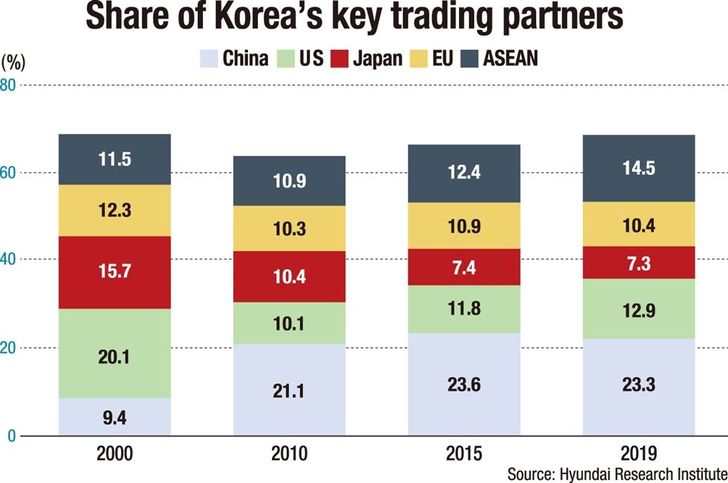
Among the few causes for optimism for Korea is a strengthening trade alliance with ASEAN nations over the past two decades.
According to the Korea International Trade Association, Korea's trade with ASEAN nations accounted for 14.5 percent of the nation's total trade in 2019, up from 11.5 percent in 2000.
Yet the countries with much growth potential cannot stay isolated from the ongoing virus scare, adding to the woes that even exports to them could be reduced due to what now seems to be a global challenge.
“Resumption of normal economic activity from Korea, China and around the world will depend on the period needed to contain the global spread of the virus,” Yonsei University economist Sung Tae-yoon said.