FSC conflicts with FSS over short selling
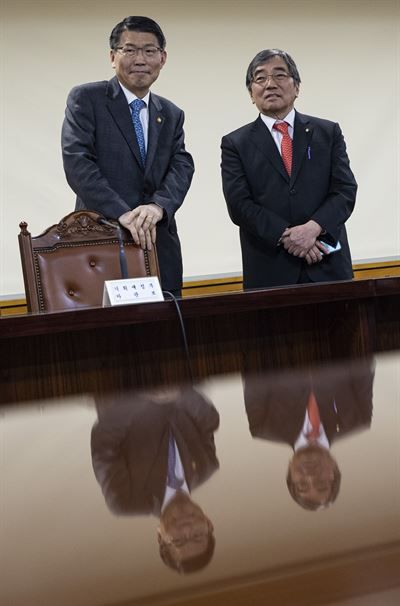
Financial Services Commission Chairman Eun Sung-soo, left, and Financial Supervisory Service Governor Yoon Suk-heun wait for Finance Minister Hong Nam-ki to come to a meeting at the Korea Federation of Banks headquarters in Seoul in this Feb. 14 file photo. / Korea Times photo by Shim Hyun-chul
By Park Jae-hyuk
The Financial Services Commission (FSC) has clashed with the Financial Supervisory Service (FSS) again over their stance on market regulations.
The FSC clearly indicated Monday that it is skeptical of FSS Governor Yoon Suk-heun's proposal to adopt “Hong Kong-style” short selling rules.
Short selling refers to the sale of borrowed shares in the hopes of making a profit from a price fall by buying the shares back at the lower price.
When the stock market tumbles, foreign and institutional investors with access to this method have made profits, while retail investors have lost money.
As the financial market has become more volatile since the coronavirus outbreak, a growing number of retail investors are calling for the government to impose a temporary ban on short selling.
Against this backdrop, the idea Yoon suggested at the National Assembly audit in October last year has drawn public attention.
“We may ban a certain part of the short selling market as Hong Kong did,” he said at that time. “Small-caps are what matters, so I think we may consider forbidding short selling of such stocks.”
Since then, the FSS has discussed this idea with the FSC. The FSS is a public agency that inspects and supervises financial services firms under the supervision of the FSC, a government regulatory authority.
In Hong Kong, stocks are only eligible to be sold short if their daily turnover exceeds 60 percent of the company's market capitalization, which must also exceed 3 billion Hong Kong dollars ($385 million).
If similar regulations are imposed on the Seoul bourse, short selling will be only eligible for large-caps whose market cap is over 470 billion won.
This may protect retail investors, most of whom hold small- and mid-cap shares.
The FSC, however, opposes regulating short selling, saying this would go against “global standards.”
“Our basic stance is that regulations should be imposed very carefully,” said Sohn Young-chae, head of the FSC's capital markets division.
“Hong Kong has limitedly short selling, since it once imposed a complete ban on the trading method. It is difficult in Korea to reach a consensus on limited permission on short selling after a complete ban, and this is the same globally.”
The FSC official's remarks are in contrast to the wishes of small investors here.
The Citizens' Coalition for Economic Justice said in a statement Friday that Korea's short selling rules were unfair, as they were designed in favor of foreign and institutional investors, since their enactment.
The Korea Stockholders Alliance comprised of 3,000 retail investors also urged the financial authorities to temporarily prohibit short selling and carry out transparent and fair regulation of the investment method.
Rep. Kim Byung-wook of the ruling Democratic Party of Korea said the government should consider forbidding the method, if it truly wants to minimize the impact of the virus on the economy.
According to the Korea Exchange, the volume of short selling on the KOSPI and Kosdaq markets in February stood at a combined daily average of 664.6 billion won, up from 340 billion won in December.