Faltering Chinese economy to hamper Korea's growth

Supply chain disruptions could hurt manufacturing sector
By Lee Kyung-min
The Chinese economy reeling from the fast-spreading coronavirus could have a worse-than-expected impact on the Korean economy by impacting the manufacturing industry through supply chain disruptions, economists said Wednesday.
They said that the extent of the fallout could be greater than that of the Severe Acute Respiratory Syndrome (SARS) outbreak in the early 2000s as the global economy relies more heavily on China, the epicenter of the deadly coronavirus.
Against this backdrop, the government is being urged to promptly come up with measures to help the adversely affected Korean business in China, while long-term efforts should continue to identify a value chain that could reduce the disproportionate dependence on the world's second-largest economy.
S&P Global Ratings said in a Feb. 7 report that the coronavirus impact will slow China's GDP growth to 5 percent in 2020.
"Most of the economic impact of coronavirus will be felt in the first quarter, and China's recovery will be firmly in place by the third quarter of this year," said Shaun Roache, the Asia-Pacific chief economist for S&P Global Ratings.
In its Feb. 7 report, Moody's Investors Service said that retail, travel and transport are among sectors most exposed to disruptions from coronavirus.
“Chinese brick-and-mortar retailers selling discretionary items, travel-service providers and transportation companies are most exposed to disruptions stemming from the coronavirus outbreak. These disruptions include transportation suspensions, travel bans and reduced customer traffic flows. The resulting credit risk is therefore highest for these companies,” the report said.
Hyundai Research Institute (HRI) expects the country's export in the first quarter will drop by a range of between $150 million (178 billion won) and $250 million due to the coronavirus.
If the deadly virus spreads rapidly in Korea, the country's growth rate in the January-March period will fall by up to 0.7 percentage points.
However, if the spread is limited within Chinese borders, Korea's growth rate will drop by a range of between 0.2 percentage points and 0.3 percentage points, according to the HRI.
The institute expects China will see a drop of a range between 0.3 percentage points and 0.5 percentage points in growth in the January-March period, which in turn will lead to up to a 0.8 percentage point drop in Korea's export growth rate in the same period.
This is based on the institute's earlier estimate that a 1 percentage point drop in China's growth rate will lead to a 1.6 percentage point drop in Korea's export growth rate.
“The ongoing spread of the new coronavirus will have a much graver impact than the 2003 SARS scare, given the rate (at which) it is spreading and the number of people infected. Major shocks in consumption and manufacturing will be clearly shown in the quarterly growth reports both in China and Korea,” HRI economist Chen Yong-chan said.
The economic effects of the outbreak have been significant across the globe due to China's emergence as a key global manufacturing powerhouse amid the slowdown of the rest of the world, according to another economist.
“It is nothing short of being kicked when you are down,” Korea Development Institute (KDI) researcher Song Yeong-kwan said.
“The global economy was not in as bad shape as it is now. The pinch is felt particularly harder by many export-driven economies that grow by making goods in and selling goods to China.”
According to the World Bank, China accounted for only 4.3 percent of the global domestic product (GDP) in 2003, but the figure increased roughly four-fold to 16.3 percent in 2018.
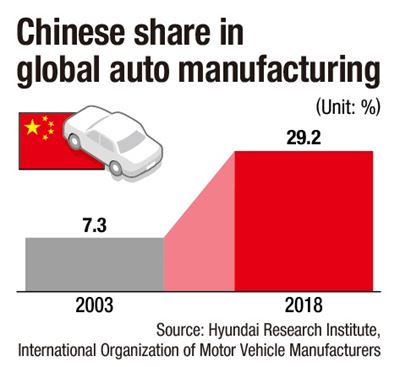
China's manufacturing capabilities improved rapidly from the mid-2000s. China accounted for only 7.3 percent of the global auto manufacturing in 2003 but the figure spiked four-fold to 29.2 percent in 2018.