Will KOSPI continue on a bullish run?

Gettyimagesbank
By Anna J. Park
The stock market will continue its upward moment after the Lunar New Year holiday but the upcoming announcement of the fourth-quarter results will limit its upswing, markets analysts forecast Thursday.
The benchmark KOSPI retreated a bit Thursday and closed at 2,246.13, down 0.93 percent from the previous session but it has gained over 70 points since the beginning of the year.
Seen from a months-long perspective, the index posted an over 16 percent increase during the last five months in a general upward movement, despite daily fluctuations.
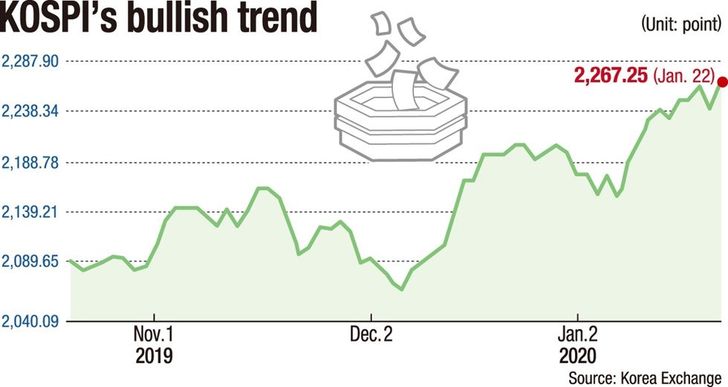
The index saw a particularly steep rise earlier this month, and experts call this tendency “the January Effect” ― the perceived seasonal increase in stock prices in the month of January.
“The January Effect is observed globally, and we see this symptom in Korea as well. It means that this first month of a year tends to have higher returns than other months,” Yeom Dong-chan, analyst at eBest Investment & Securities, told The Korea Times.
Yeom, however, warns the January Effect does not guarantee this current rally will continue on even after the four-day holidays from Jan. 24 through 27.
“In Korea, 98 percent of listed firms settle their accounts in December. It means that those companies' last yearly quarter is three months from October through December. As Korean firms are used to settling asset depreciation and other yearly costs in the last quarter, their fourth quarter results tend to have a lower performance than other quarters,” Yeom explained.
He said most listed companies report their fourth quarter results either at the end of January or early February. This year, fourth quarter results are expected to be announced after the Lunar New Year's holidays.
“The current upswing stock market could be swayed by the time those fourth quarter results are coming in later this month or early next month. However, it's true that the current market sentiments, global contexts and composite leading indicators (CLI) are not bad as of now,” he added.
In this continuing rally, surged stock prices of global chipmakers from Korea, including Samsung Electronics and SK hynix, are receiving much media attention for their strong performances. During the last three months, both semiconductor-makers' stock prices jumped more than 20 percent as of the closing of Jan. 17.
Yet, what should be noted is that other tech stocks like Kakao and Naver, as well as stocks related to overseas consumers or tourists, such as cosmetics or duty-free shops, have witnessed even more hikes in their stock prices during the past three months.
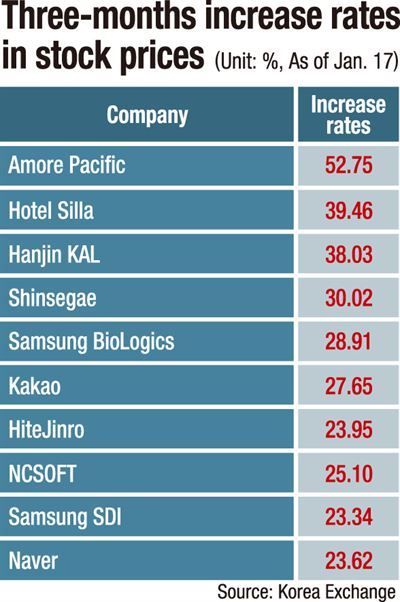
Analysts say, investors are more and more interested in picking companies that demonstrate an obvious potential for growth, and most of these strong growth momentum lies in overseas customers or inbound tourists. Stocks related to Chinese consumption, which were expected to be enhanced with a signing of the U.S.-China trade deal, have also seen increases.
In particular, cosmetics conglomerate Amore Pacific saw more than 50 percent increase in their stock price during the last three months, which is the highest profit rates in the KOSPI index.
“There are various reasons behind the increase of Amore Pacific. The company's revenue results got better, its high-priced items were sought after, and the company has raised cost efficiency using online duty-free shops,” Na Eun-chae, analyst at Korea Investment & Securities told The Korea Times.