Korea's breadwinners keep losing jobs
By Lee Kyung-min
The number of jobs for breadwinners, mostly those in their 30s and 40s in the manufacturing sector, continued to drop in November, while jobs for those in their 60s and older have been on the increase, data showed Wednesday.
This indicates that the nation's workforce has become older as a result of the government's policies to create more part-time jobs for older people. Companies have been reluctant to hire new employees due to rigid labor policies amid economic slowdown.
Statistics Korea data showed over 27 million people were employed in November, up 331,000 from a year earlier, the fourth consecutive month of increases.
The jobless rate stood at 3.1 percent, down 0.1 percentage points from the year before. The employment rate for those aged between 15 and 64 stood at 67.4 percent, the highest November figure since the agency began compiling data in 1989.
However, many economists said that the improvement in overall job data should not be taken as an indicator of job market recovery because jobs for those in their 30s and 40s, the backbone of the economy, have continued on a downward spiral.
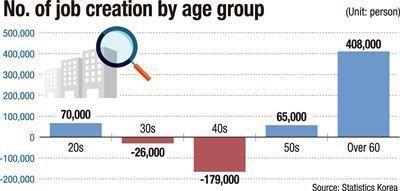
According to the statistics agency, 179,000 people in their 40s lost jobs, while 408,000 jobs were added for people over 60. Similarly in October, 146,000 jobs for those in their 40s disappeared, while 417,000 jobs were created for those aged over 60.
By sector, manufacturing ― largely considered a high-quality job producer ― lost 26,000 jobs in November, continuing its losing streak for 20 consecutive months. In October the former key growth driver of the economy shed 81,000 jobs.
Wholesale and retail ― another key producer of the country's middle class jobs ― lost 88,000 jobs in November, a sharp increase from the 67,000 jobs lost in October.
Yun Chang-hyun, an economist at the University of Seoul, said that the government should recognize the clear limit of the current employment policy.
“The government has added low-quality jobs for senior citizens. This has no desired effect on creating decent, sustainable jobs that could underpin the economy. Policymakers should promptly seek to modify policies instead of cherry-picking data to save face,” he said.
Following the release of the November job data, Finance Minister Hong Nam-ki said the economy added over 300,000 jobs per month for fourth months in a row from August, adding the job market is showing clear signs of recovery.
“The economy is showing robust signs of job market recovery, indicated by the number of jobs created, employment and unemployment rates,” Hong said.
“The rapid fall of the manufacturing job losses over the past few months has slowed. The youth employment rate is the highest since 2005, and their jobless rate has slid to the lowest since 2012. These give reasons for a positive outlook.”
Economists view Hong's assessment is erroneous, or naive at best.
“It is simply out of touch with reality,” said Sung Tae-yoon, an economist at Yonsei University.
“Of the added jobs, most of them are held by those aged over 60 and the quality of the jobs are indisputably awful. What the government is eager to call jobs are merely a couple of hours of time-killing activities at best.”