Soaring home prices force people to leave Seoul
By Lee Kyung-min
The number of people living in Seoul continued to drop over the past few months, an indication that more people have moved out of the capital due to soaring housing prices, government data showed Wednesday.
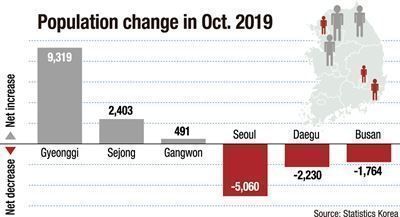
According to Statistics Korea, Seoul suffered a net outflow of 5,060 people in October, as 133,127 left while 128,067 moved into the capital. This followed a decrease of 7,100 in July, 7,400 in August and 5,500 in September.
This is in contrast to Gyeonggi Province which saw a net inflow of 9,319 after 164,544 moved in and 155,225 left.
“This could indicate that most people who left Seoul settled in Gyeonggi Province, the area surrounding the capital, due to soaring housing prices,” a Statistics Korea official said.
Gyeonggi is host to several satellite cities of Seoul that have been built to distribute housing demand out of the capital.
Except for February 2019, Seoul has seen a net outflow in its population for the past few years.
Other than Gyeonggi Province, Sejong administrative city logged a net population increase of 2,403, followed by Gangwon and North Chungcheong provinces and Jeju.
Experts say this is due to Seoul's ever-rising housing prices as government measures to curb this are apparently backfiring. .
“Those that cannot bear the housing price have few options,” Seoul National University Economics professor Lee In-ho said.
“Home prices spiked further after the government put a cap on presale prices. Former Seoul residents are forced out to the surrounding Gyeonggi Province and Incheon. I am afraid to say that the situation is likely to worsen.”
According to an analysis by the statistics agency, more than 1 million people left Seoul from 2010 to 2018. Around 110,000 people left last year alone.
Seoul's population peaked at 10.3 million in 2010 and has since dropped to 9.73 million in 2018. Incheon had a population of 2.95 million in 2018, a continued increase from 2.71 million in 2009.
That of Gyeonggi Province surpassed 13 million for the first time in 2018, a continued upward trend since 2009 when it had 11.4 million.
Partly driving this, Lee added, is a comprehensive city development plan including setting up public transport systems across Gyeonggi and the southeastern part of Gangnam, southern Seoul.
“Gyeonggi has a high connectivity to Seoul thanks to the development of the high-speed Super Rapid Train (SRT) and the Great Train Express (GTX) that connect key areas in Gyeonggi and Seoul. Office workers with reduced commuting hours may not think living in the province as that bad of an idea,” Lee said.