Korea's growth potential at bottom among OECD members
By Lee Kyung-min
Korea's growth potential has dropped sharply to third-last among the top 36 advanced economies due to its falling birthrate and rapid population aging, data showed Sunday.
Economic growth potential is the gross domestic product (GDP) growth that can be experienced without causing inflation. A failure to achieve this means the economy will have difficulty growing without triggering inflation in the future.
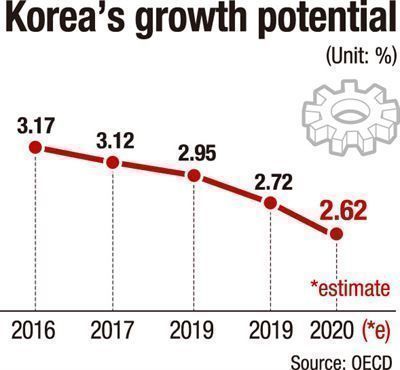
According to the Organization for Economic Cooperation and Development (OECD), the potential growth rate of Asia's fourth-largest economy dropped to 2.7 percent in 2019, a 0.4 percentage points fall from 2017.
This is followed only by Turkey, whose rate dropped from 5.6 percent to 4.9 percent in the period, and Ireland with a sharper drop of 1.6 percentage points from 5.3 percent to 3.7 percent.
Eighteen other OECD members, on the other hand, saw increases, including the U.S., whose rate stood at 2 percent in 2019, up 0.1 percentage point from 2017.
The OECD outlook is slightly upbeat from that of the Bank of Korea (BOK), which estimated that the rate will fall to between 2.5 percent and 2.6 percent in 2019 and 2020.
The BOK and many other domestic and foreign financial organizations have long warned of the rate falling faster than previously thought due to slower-than-expected economic activity participation.
This is mostly due to a nosedive in the birthrate amid a fast-aging population, with little to no momentum to boost labor productivity in a country best known for rigid labor regulations that businesses say enable militant unions to protect vested interests.
Adding to the woes are heightened uncertainties following the drawn-out U.S.-China trade feud and a fresher one with Japan over export curbs of key materials needed to make semiconductors and display panels.
The rate will continue to decline, according to Yun Chang-hyun, an economist at the University of Seoul.
“The number of young, working-age people will fall markedly in the coming years amid the low birthrate in a fast-aging society,” he said. “Weak corporate investment amid the slowdown and pillar industries no longer generating as much profit as they used to are all major concerns to the country's growth potential.”
Businesses should be granted greater discretion over labor force management decisions, he said.
“Under the current structure, hiring and firing is nearly impossible,” Yun said. “Creating a business environment by promptly removing heavy, unnecessary regulations, including labor-related ones, will help draw investment not only from domestic investors but also foreign ones.”