BOK cuts key rate to record low 1.25%
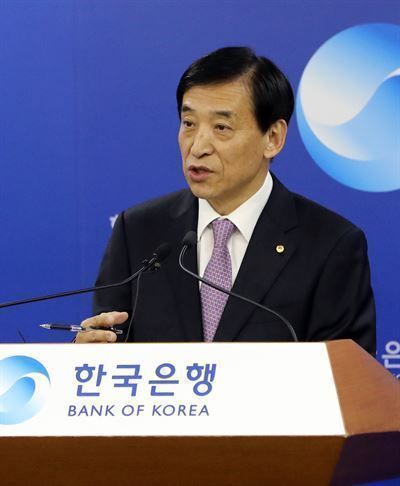
Bank of Korea (BOK) Governor Lee Ju-yeol answers questions from reporters at the BOK headquarters, Oct. 16. Yonhap
Governor Lee keeps door open for further easing
By Lee Kyung-min
The Bank of Korea (BOK) lowered its key interest rate by a quarter percentage point to a record-low 1.25 percent, Wednesday, citing sagging exports and weakening private consumption amid mounting uncertainties both at home and abroad.
The central bank also left the door open for further easing in the coming months on growing fears over a global recession amid the deepening trade feud between the United States and China. The new rate is the lowest since June 2016.
“Ongoing negative developments continue to weigh on the economy, notably exports and investment,” BOK Governor Lee Ju-yeol said at the press conference at the bank's headquarters in Seoul.
“Dominated by growing uncertainty from negative developments here and around the world over the past few months, we judge that a 25 basis point rate cut was warranted,” he added.
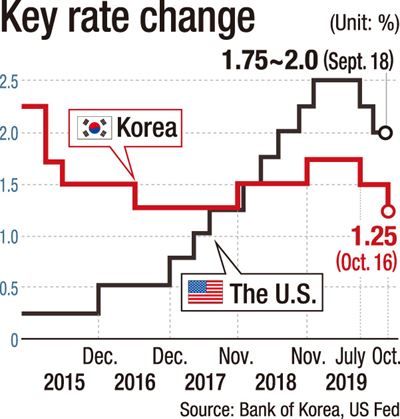
Despite the “rapid” 50 basis point cut over three months, Lee indicated further cuts could be possible if the country's economic condition deteriorates.
The BOK lowered its key rate to 1.5 percent from 1.75 percent in July, but left it unchanged in August.
“Monetary policy still has considerable room to maneuver. We are not considering non-conventional methods such as quantitative easing at this point, but studies are ongoing to determine whether such measures undertaken by advanced economies could be implemented in Korea,” Lee said.
The ongoing Korea-Japan trade feud has yet to take a toll on the economy, but further monitoring is required given that industries in both countries are closely connected, he added.
The BOK's rate cut came after the U.S Federal Reserve reduced its benchmark short-term rate to the range of 1.75 percent to 2 percent in September.
Sung Tae-yoon, an economist at Yonsei University, said that the BOK's latest move was warranted given the steeper-than-expected downturn.
“The central bank has limited options given the current economy being dragged down by the rapid increase of labor costs. The rate cut will not induce the desired effect fast enough, but it still bears significance as it will help the economy decline slower,” he said.
The central bank's rate reduction was based on its gloomy outlook for the near future of the Korean economy.
“This year's growth rate is likely to fall short of 2.2 percent forecast in July,” Lee said.
The BOK said consumption was weakening amid the continued sluggishness in facility and construction investment, while exports were falling due to unit price drops of semiconductors and petrochemical products.
In its latest outlook reported Tuesday, the International Monetary Fund (IMF) lowered Korea's 2019 growth forecast to 2.0 percent from 2.6 percent, citing China's slowing growth and the spillover effect of the U.S.-China trade war. It also downgraded its outlook for next year to 2.2 percent from the 2.8 percent it forecast in April.
The IMF predicted the global economy will grow by 3.0 percent this year, down from its earlier outlook of 3.3 percent, and the lowest rate since 2009.
The Tuesday rate reduction was widely expected as fears have abounded recently over the Korean economy entering a so-called new normal of “three lows” ― growth, interest rates and inflation ― a rather bleak combination of economic conditions already in progress in many advanced countries.
Economic experts have warned that the much-feared economic conditions are fast becoming a reality after consumer prices dropped for the second month in a row in September, the first time in the 54 years the statistics agency has been compiling the relevant data.