Provincial economies suffer deepening slump

gettyimagesbank
By Lee Kyung-min
Korea's southern regions, which have been reeling from stagnant shipbuilding, shipping and auto industries, are increasingly exposed to deflation risks as a fall in consumer prices has been coinciding with a fall in asset prices there for the past few months.
The unsavory development in the regions came as the country saw consumer prices drop two months in a row, for the first time since 1965 when the statistics agency began compiling related data. The unprecedented situation is fanning worries over deflation, a decline in the general prices of goods and services.
The regions ― Ulsan, North and South Gyeongsang provinces ― are home to major traditional manufacturing facilities, the once-significant growth driver of Asia's fourth-largest economy.
Slowdown there, experts note, is an indication of how the rest of the country will be hit in the coming months amid a clear downturn.
According to data from Statistics Korea and the Bank of Korea (BOK), consumer prices in Ulsan in September dropped 1 percent from the year before.
In the same period, both South and North Gyeongsang Provinces saw the figure drop 0.9 percent from the year before.
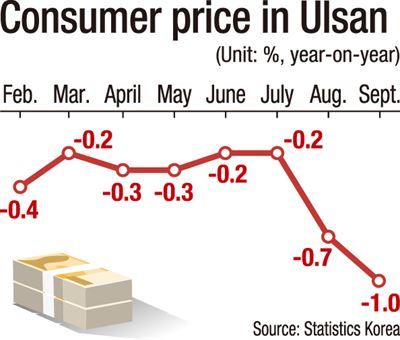
Ulsan's year-on-year drop that continued for eight consecutive months resulted from a price decrease in industrial products, a clear indication that the recent price drop cannot all be explained by the government-claimed culprits ― the price drop of agricultural produce and a spike in oil prices.
This came as consumption there weakened as people lost jobs and spent less.
“The most frightening aspect is what is observed there could now be seen in the rest of the county, notably the decrease in both people's income and asset value, Yun Chang-hyun, an economist at the University of Seoul said.
“People earning lower incomes consume less, and the property market along with many other financial markets will become stagnant, indicated by the decrease in the home prices there. It could mean a downward spiral,” he said.
He pointed out that the situation will worsen in the coming months, given businesses are reluctant to hire, which means little improvement in the unemployment rate. “People earning less are not inclined to spend, and this weakens consumption further. The economy will take a further hit and more people will be hurt.”
The finance ministry and the central bank continues to fret to contain the fear citing the “one-off, supply-driven base effect” from last year's heat wave and spike in oil prices.
The BOK has dismissed concerns over possible deflation.
“Deflation is defined by general, broad and continued decline of the price level of goods and services, but the sharp drop in the consumer price was induced by supply-side factors not demand-side ones,” it said in its report.