Fear of deflation looming larger amid slowdown
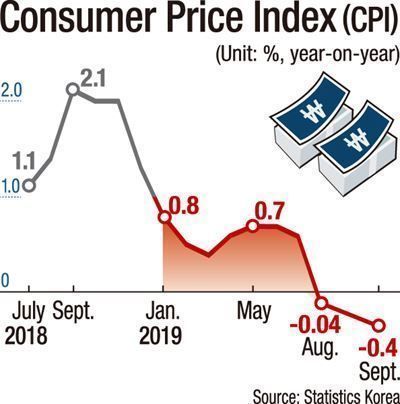
Consumer price falls for 2 months in a row
By Lee Kyung-min
Concerns about deflation ― a decline in the general prices of goods and services ― are spreading fast after government data Tuesday showed consumer prices fell for two consecutive months in September, a first in the country's history.
The finance ministry and the central bank fret to contain the fear citing the “one-off, supply-driven base effect” from last year's heat wave and spike in oil prices.
Yet experts say the unprecedented data could put Asia's fourth-largest economy on a faster-than-expected downward spiral amid a clear downturn.
This is indicated by exports that fell for 10 months in a row, clouded further by a Korea-Japan trade feud expected to take a considerable toll in the coming months.
Statistics Korea said Tuesday that the consumer prices measured as headline inflation fell 0.4 percent in September from the year before, mostly due to a price decline in agricultural produce and petroleum products as well as increased public spending on free education for high school seniors.
While core inflation, excluding the volatile food and energy prices, was up 0.6 percent from the year before, it was still around historic lows. This month's core inflation was the lowest since September 1999 when it increased 0.3 percent from the year before.
The consumer price dropping for two consecutive months is the first since 1965 when the statistics agency began compiling related data. In August, it dropped 0.038 percent from the year before.
The decline came after the consumer price growth rate had stayed below the 1 percent threshold for eight consecutive months since January.
The statistics agency stressed the data do not signal deflation as the price drop was led by volatile items.
Agricultural produce, marine products and livestock dropped 8.2 percent in September from the year before, while that of petroleum products slid 5.6 percent.
“The record-low consumer prices came as a result of base effect in consumer prices last year, added on by expansion of free education and strengthened national health insurance coverage in September,” a statistics agency said. “The prices will pick up by the end of 2019. The data does not signal deflation.”
However, economists deem otherwise.
“Korea has practically entered the initial phase of deflation,” said Sung Tae-yoon, an economist at Yonsei University.
“Many businesses are experiencing a fast-deteriorating business environment due to falling demand, which may contrast with how consumers feel about everyday food prices.”
Unlike the U.S. whose economy is backed by strong consumption, wage growth and jobs data is robust enough to absorb shocks from external uncertainties, Korea should brace to be hit harder given its export-reliant economy, he said.
“With the ongoing trade spat with Japan, the data should alarm the government and relevant authorities as they came amid economic outlook on a continued downgrade. Recognizing that there is a problem will help map out proper economic and fiscal policies,” he said.
Meanwhile, the Bank of Korea maintained its view against deflation.
“Deflation is defined by general, broad and continued decline of the price level of goods and services, but the sharp drop in the consumer price was induced from supply-side factors not demand-side ones,” it said in a statement.