China slowdown feared to drag down Korean economy
gettyimagesbank
By Lee Kyung-min
Korea is expected to bear the brunt of China's weaker-than-expected growth as shown by recent key economic indices, analysts said Wednesday.
The assessment fuels concerns that Asia's fourth-largest, export-reliant economy, already under growing concern due to deflation ― a decline in the general prices of goods and services ― will be further hurt by its top trading partner's economic slowdown.
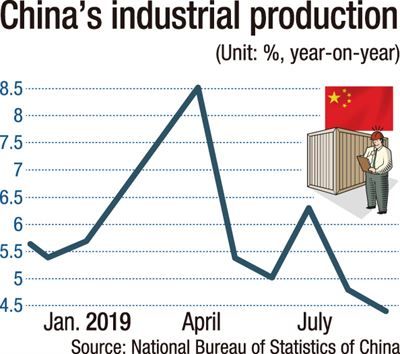
China saw its industrial production increase only 4.4 percent in August from a year earlier, a further slump from the previous month when it grew by 4.8 percent, its weakest growth in 17 years.
The figure was also worse than the market consensus which expected 5.2 percent growth.
Industrial production measures the output of key businesses including the manufacturing, utilities and mining sectors.
According to the Korea International Trade Association (KITA), China accounted for over a quarter, or 26.8 percent, of Korea's exports in 2018.
Other data from China's National Bureau of Statistics showed retail sales growth slowed to 7.5 percent in August, down 0.1 percentage point from 7.6 percent in July.
Following this series of disappointing data, the Chinese government expects that the world's second-largest economy will be unable to hit its growth target in 2019.
In an interview with Russian media, Chinese Premier Li Keqiang said, “For China to maintain growth of 6 percent or more is very difficult against the current backdrop of a complicated international situation and a relatively high base, and this rate is at the forefront of the world's leading economies.”
China's gross domestic product (GDP) expanded 6.3 percent in the first half of the year.
The slowing Chinese economy is adding to concerns that exports from Korea will be significantly hurt, according to an economist specializing in China.
“A 1 percentage point drop in China's gross domestic product (GDP) is expected to result in a 0.5 percentage points drop in Korea's GDP,” Hyundai Research Institute (HRI) economist Chen Yong-chan said.
Worse yet, the growing fear is that the reality could be much worse than what the already low figure bears out, according to Sung Tae-yoon, an economist at Yonsei University.
“The 17-year low industrial production figure in and of itself is a cause for grave concern, but the bigger worry is that suspicions abound over whether the statistics accurately reflect the real economy,” he said.
Slow growth inevitable
Korea should continue monitoring whether the world's second-largest economy can manage to stay on track following expansionary fiscal policies, implemented with full awareness of a gradual-yet-inevitable slowdown in the coming months, Chen noted.
“The Chinese government has been increasing investments, notably in the construction sector to help buoy the economy. This was also to offset the fast deteriorating corporate profits in the fourth quarter of 2018. It will take some time for the measures to be felt by Korea,” Chen said.
Figures from Chinese authorities indicate, according to Chen, corporate profitability has been showing clear signs of waning since October 2018, falling up to 30 percent from a year earlier. Feeling a particular pinch was the manufacturing sector.
“The woeful latest figure is not too far off from market expectations, but we have to also realize that the Chinese economy has reached a point where it can no longer grow at the rate it once did,” he added.
The bigger problem is that the economy has no growth momentum ― both near-term and long-term.
“The upcoming October holiday which will continue for about a week will reduce the number of business days for Chinese companies and thus translate into weaker industrial output. Given the figures are calculated on a monthly basis, the implication is greater, as up to a third of the month's total output could be affected,” he added.
Unlike the growing projections, however, the Chinese authorities will not let its growth rate fall below 5 percent, even if doing so requires “state intervention.”
“This year marks the 70th anniversary of the founding of the People's Republic of China. So to help maintain the upbeat national sentiment, the authorities there will come up with expansionary fiscal policies albeit with all-too-obvious political purpose,” Chen said.