'It is high time for BOK to lower key rate'
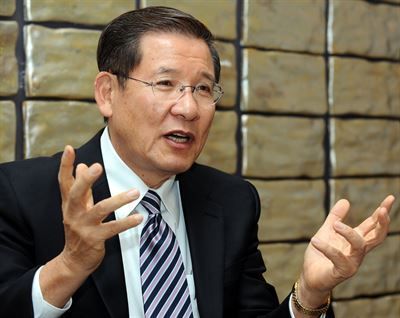
Sohn Sung-won, a finance and economics professor at Loyola Marymount University in Los Angeles.
By Lee Kyung-min
The central bank should lower its key rate as soon as possible to help buoy the sluggish economy and achieve the best policy mix with fiscal expansion, according to a noted economist, Monday.
Sohn Sung-won, a finance and economics professor at Loyola Marymount University in Los Angeles, said that current concerns of the bank, seeking to achieve “inappropriate goals,” should be reorganized to prioritize growth.
The Bank of Korea (BOK) has insisted on monitoring soaring household debt and massive foreign capital outflow, two major factors that could severely undermine financial stability.
“Of course those are important considerations, but there are other more important factors such as economic growth,” he said.
The BOK has more room to maneuver as the U.S. Federal Reserve has recently shown signs of taking a dovish stance, he added.
“Now that the Federal Reserve has realized that its policy was too restrictive, it is high time for the BOK to realize their mistake and lower the interest rate.”
Federal Reserve Chairman Jerome Powell hinted at a rate cut on June 4, saying the U.S. central bank was “prepared to act” to help the country's 10-year economic expansion if the ongoing trade war continues with China, Mexico and other nations.
Soon after the notable dovish turn, BOK Governor Lee Ju-yeol also hinted at a possible rate cut June 12, saying the central bank would take “appropriate measures.”
In Sohn's view, the BOK needs to change what he considers a monetary policy far from “accommodative.”
“For some time going back a few years, monetary and fiscal policies have been too tight, the latter of which can be considered a legacy of the Asian Financial Crisis in the 1990s,” he said.
An expansionary fiscal policy could help boost the economy given Korea's financial health, measured by the national debt-to-gross domestic product (GDP) ratio.
“Korea's net debt is only 38 percent of GDP compared to the European Union average of 83 percent and the global average of 61 percent,” he said.
The policy mix of expansionary and fiscal policy may help offset side effects resulting from the “income-led” growth, a signature economic policy of President Moon Jae-in, defined by rapid hourly minimum wage increases, he noted.
Korea's sluggish economy can be blamed in part due to too much emphasis being put on equitable income distribution over economic growth, he noted.
“The Korean people voted Moon into office knowing full well such policies would slow down economic growth. Additional government spending should be considered and can help the economy assuming it can be put to productive use,” he added.