Economic sentiment falls again over uncertainties
By Park Hyong-ki
Indices measuring consumer and business sentiment have dropped due to growing uncertainties both at home and abroad.
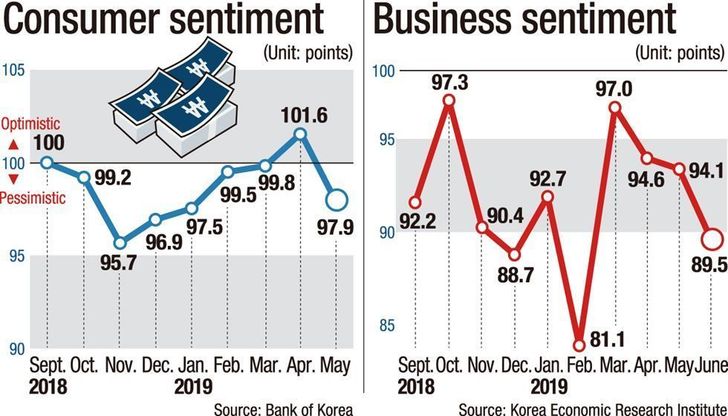
The Bank of Korea's (BOK) consumer sentiment index stood at 97.9 points in May, down 3.7 from the previous month.
This marks the steepest fall since July last year when the index dropped 4.6 points.
The threshold for this index is 100. A number lower than 100 means there are a lot more consumers with a bleak outlook than those with a positive one.
The index fell to 95.7 in November last year, then it climbed for five consecutive months, reaching 101.6 in April this year.
But the climb did not last long due to falling exports, low inflation and high unemployment.
Analysts say the U.S.-China trade war will continue to have a big impact on the trade-dependent economy, which resulted in a contraction in the first quarter.
This external factor is making it hard for the government to rebuild confidence in the economy, they said.
“We expect the index to remain under 100 because we do not see the trade conflict being resolved anytime soon. The war has affected Korea's fundamentals,” said Kim Doo-un, an economist at KB Securities.
The trade war had an effect on another index measuring business sentiment.
The Korea Economic Research Institute's (KERI) business survey index (BSI) stood at 94.5 in May.
It has been under 100 for 49 months.
The private think tank's survey of 600 companies projects the index will be 89.5 in June, falling below 90 again.
The last time it fell below that level was in February 2019 when it was 81.1, according to the KERI.
The business sentiment's threshold is the same as that of the consumer sentiment index.
The BSI has been dragged down by weakening consumer sentiment, beset by poor employment data, analysts say.
The survey said unemployment has risen because of the rapid rises in the minimum wage and the 52 hour workweek system.
These made it harder for companies to increase hiring.
“The rising labor costs without boosting productivity have severely dealt a blow to the economy,” said Sung Tae-yoon, an economist at Yonsei University.
The government introduced a supplementary budget, with a key focus on boosting exports through credit financing programs, tackling fine dust and rebuilding fire-scarred areas in Gangwon Province.
“Many Asian economies have the scope to use fiscal and monetary measures to boost economic growth to mitigate the impact of weak export growth,” said Rajiv Biswas, chief economist at IHS Markit in Singapore.
“The escalating US-China trade war would also reinforce trade diversion effects, as U.S. buyers shift their orders to other manufacturing hubs.”
Countries such as Vietnam, Malaysia and Thailand are likely to benefit from some diversion of U.S. export orders, he added.