Key economic indices rebound on base effect
Growth will slow, but unlikely to enter recession
By Park Hyong-ki
Korea saw a “triple rebound” in indices measuring industrial production, investment and consumption in March, according to Statistics Korea, Tuesday.
But analysts said these were a “one-off rebound” on the back of a so-called base effect.
This means since the numbers in February were so low due to the Lunar New Year holiday, the March indices showed gains on the surface. Exports and investment usually fall in February.
The current situation mirrors two other indices measuring the current and future economic cycle, they added.
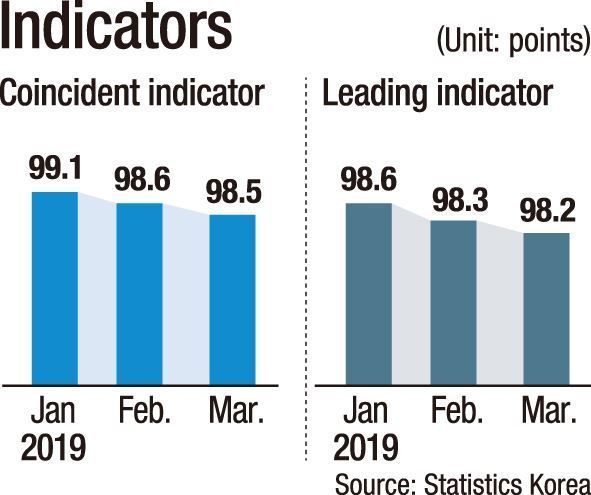
The coincident indicator stood at 98.5 points in March, having fallen for 12 consecutive months. The leading indicator that projects the cycle reached 98.2, sliding for the 10th straight month.
This marks the first time in 49 years for the two indices to fall simultaneously for 10 consecutive months, according to Statistics Korea.
A figure below 100 indicates the economy is slowing, and could be potentially heading for a recession should it decline further.
“We had a one-off rebound. The overall situation is the economy will continue to face a slowdown amid weak demand,” said Sung Tae-yoon, an economist at Yonsei University.
“But we are very unlikely to see more negative growth in the second quarter of this year and enter a technical recession, after contracting 0.3 percent in the first quarter.”
Rajiv Biswas, chief economist at IHS Markit in Singapore, agreed, saying the economy will remain under pressure amid slow global demand and production.
“Following the 0.3 percent contraction, the leading indicator signals continued weak demand in the coming months,” Biswas said.
“Korean manufacturers are facing weak demand in China and Europe, while slowing domestic output is also dragging on growth.”
Due to falling exports, particularly to China and the European Union, Biswas suggested additional measures to stabilize the economy this year.
“Further fiscal stimulus measures will be needed in 2019 from the Korean government in order to keep its annual growth above 2 percent,” Biswas said.
The recent 6.7 trillion won ($5.8 billion) supplementary budget announced last month will not be enough to support short-term growth, even though Korea will not enter a recession.
Overall industrial production increased 1.1 percent in March from the month before, after falling 2.6 percent in February. Overall production excludes output from the agriculture and fishery sectors.
Retail sales also climbed 3.3 percent, after falling 0.5 percent, the highest gain in 49 months because of the base effect. The rise in consumption was attributable to an increase in the purchase of air filters due to fine dust.
Facility investment climbed 10 percent last month, the sharpest gain in two years, according to the statistics agency. It fell 10.2 percent in February, after increasing 2 percent in January.
The rebound in investment is mostly due to companies investing in air transportation logistics and fifth-generation (5G) telecommunication networks.