VIDEO Foreign investors look to South Korea for guidance on North Korea

John Walker, chairman of Macquarie Korea, gesticulates during a recent interview with The Korea Times. Korea Times photo by Shim Hyun-chul
By Oh Young-jin
The story about Macquarie's logo sounds like one about the egg of Columbus. The Italian explorer was the first westerner to discover the Americas, and how he made an egg stand is one of the best known stories about him.
Although not so well known, Macquarie's coin shares the same spirit of ingenuity ― when short of coins, Macquarie, an early Australian leader, imported 40,000 coins and punched holes in them, making two coins out of one ― the Holey and the Dump ― to produce 80,000.
John Walker may have used much of that Macquarie spirit, when he came to Korea 21 years ago to set up the Korean operation of the world's largest infrastructure asset manager. Under Walker, the operation has grown, covering extensive portfolios ranging infrastructure to securities.
Now Walker's Macquarie may be looking at another big opportunity in North Korea, a nation with a great deal of natural resources at the crossroads of China, South Korea, Japan and Russia as well as of interest to the United States. What this totalitarian country needs is a lot of infrastructure to replace the existing one which has been in disrepair under decades of isolation.
How does he see it ― an opportunity that is too good to pass or poisoned chalice?
He keeps his card close to his vest. So one could only follow his thought process on it, which comes down to “no hurry.”
About a solution to the problem of fine dust in Korea, he talked about setting up a skyscraper as one huge purifier in the middle of the city. A cynic in me suggested (with immediate regret) that the people may make their own contributions by using their own portable purifier ― their lungs. Again, his advice is that it is a long game and needs patience to resolve it.
“We're we're watching what's happening in North Korea. So it's really hard to tell,” Walker started.
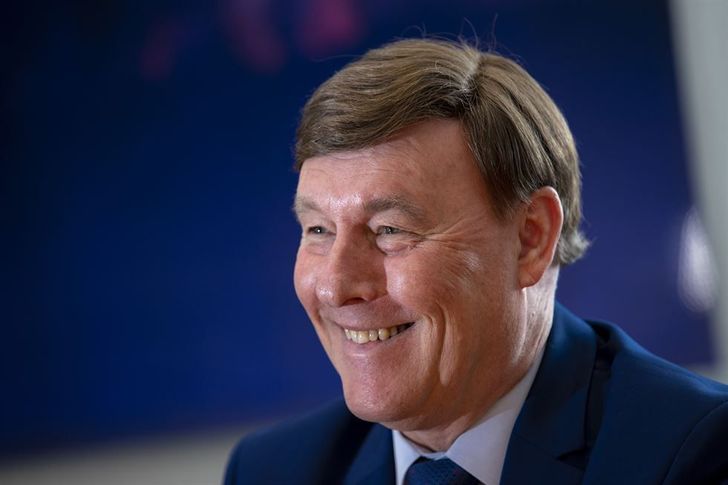
Macquarie's John Walker Korea Times photo by Shim Hyun-chul
His assessment reflected the fluidity of the situation in North Korea. Although it has come out to engage with the outside world under its young leader Kim Jong-un, the North has shown its unpredictability or more preciously the lack of ability to deal with the changing external environment.
Kim was caught off guard in February when U.S. President Donald Trump short-changed him in their second summit in Hanoi, Vietnam. Kim appears to be at a loss, not knowing whether to continue negotiations with the U.S.
Walker obviously captured the mixture of North Korean ambivalence and inexperience that combine to make it look untrustworthy in outsiders' eyes, when he said, “I am worried about things like sovereign risk.”
“A lot of companies are looking at the South Korean government and asking it what support it will give,” he said.
But Seoul has its hands tied.
President Moon Jae-in is trying to help the North open up but he has time and again found out how little he can do between the North and the U.S., the two old foes that demand the other make the first move: the U.S. wants the North to denuclearize first, while the North wants the U.S. to provide it with survival guarantees.
So far, the two have run parallel and will likely continue to do so for some time to come.
Moon has tried unsuccessfully to reopen the closed industrial complex in the North Korean city of Gaeseong and tourism to Mt. Geumgang to ease a chokehold on its cash flow in the face of U.S. opposition. Meanwhile, international sanctions have been tightened on the “Stalinist” state with some predicting if they are kept on, Kim may not last for long.
Then, Walker offered measured optimism.
“Developing economies are always difficult at first for foreign investors because they don't have developed systems, but over time with the support of multinationals and other governments eventually, that sort of development will happen.”
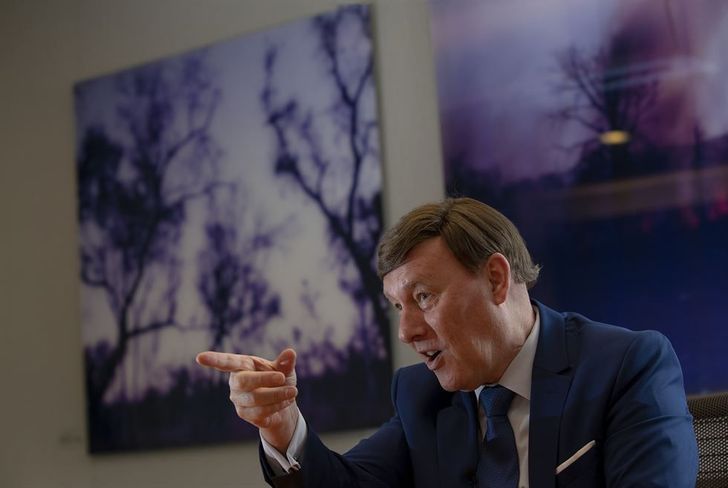
Macquarie Korea Chairman John Walker Korea Times photo by Shim Hyun-chul
Regarding the fine dust issue, he said it would take time but it is solvable. “It will be a gradual process. There's not going to be an overnight solution.”
Obviously, the sources of fine dust are clear: auto emissions, coal power generation, etc. Renewable energy could be a key to solving it, he said.
“Offshore wind is one,” he said. “We have a visibility of two gigawatts or $20 billion” regarding Macquarie's projects in Korea. He added that the project is in an early stage and wind power is “a long game.” One gigawatt is equal to power generated by 431 utility wind turbines or 3.125 million solar panels, according to the U.S. Department of Energy. It can supply 300,000 to 750,000 homes.
That project is tempting as it comes with a more healthy energy mix and provides a number of decent jobs. This may sound good news to the Moon administration that is going all in for renewable to the point of giving up nuclear power in its energy policy. President Moon is taking a lot of flak for it.
Walker suggested a longer transition period.
Batteries are an obvious alternative for Korea with Samsung and LG being the leaders in the field, according to Walker. They will provide energy for weeks on power stored without resorting to dirty coal power generation.
There are cities in the world where lifts consume power when they go up and generate it when they come down. He said that some Korean companies are interested in this.
Hydrogen is a clean source of energy as its end product is water, he said, while emphasizing efficient use of power can be as important. In the end, it is as much competition as cooperation, when he said, “We can only be stronger, if countries cooperate.”
Now, Korea and China, for example, are feuding with each other ― Seoul blames Beijing for pollutants that make up much of the fine dust blowing over its skies, while the latter denies it. Reports have it that, although the number varies, China accounts for up to 70 percent of fine dust that fog Korean skies for days in a row and force Koreans to wear protective masks.
As Walker said, no cooperation means no solution. If the two start to cooperate, then I wouldn't be surprised to see the Australia not far behind.