BOK lowers growth outlook to 2.5%

Bank of Korea Governor Lee Ju-yeol bangs a gavel during a monetary policy committee meeting at the central bank in Seoul, April 18. Yonhap
Key interest rate unchanged at 1.75%
By Lee Kyung-min
The Bank of Korea (BOK) has cut its 2019 economic growth outlook to 2.5 percent citing worse-than-expected exports and sagging investor sentiment.
The figure was down from an earlier forecast of 2.6 percent in January and 2.7 percent in October 2018.
“Facility and construction investment in the first quarter has been weaker than forecast previously,” BOK Governor Lee Ju-yeol said at a press briefing.
“The revision does not account for the possible impact of the budget because the amount, expenditure and timelines are not finalized.”
In a statement released earlier in the day, the central bank said domestic economic growth has moderated somewhat as an increase in consumption has temporarily slowed, facilities and construction investment have continued undergoing adjustments and export growth has continued to slow.
Despite the outlook downgrade, Lee remained upbeat about the future course of Asia's fourth-largest economy expecting it to grow faster in the second half in line with a recovery of chip sales overseas.
“According to data we reviewed, the current semiconductor industry is undergoing an adjustment after an outstanding performance over the past two years. Growth will recover in the latter half of the year,” Lee said.
The revised growth outlook comes after similar forecasts by global financial institutions and ratings agencies.
Moody's Investors Service lowered its 2019 growth outlook for Korea to 2.1 percent from an earlier forecast of 2.3 percent last November. Similarly, S&P Global lowered its outlook to 2.4 percent from 2.5 percent in a report on Asia-Pacific quarterly forecasts.
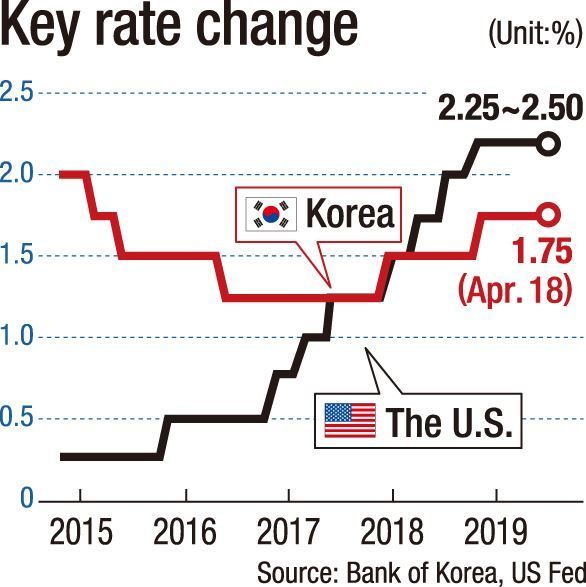
Reflecting sluggish exports and investment, the central bank left the key interest rate untouched at 1.75 percent the same day.
Lee made it clear that the central bank will not lower the rate just to boost the current administration's economic policies.
“The current monetary policy is already accommodative enough to the point where no substantial negative pressure is exerted on the real economy,” he said.
The remark was made in response to a question on whether the BOK should help revitalize the sluggish economy by adjusting monetary policy in accordance with the administration's economic directives to draw a better outcome from an “efficient policy mix” standpoint.
Lee said the country's economic condition will improve on the back of the government's expansionary fiscal policy in the months to come. He expects the economy will grow even faster if the ongoing U.S.-China trade dispute sees a breakthrough faster than expected.
On expectation that exports will rebound in the second half, the BOK kept its 2020 growth forecast intact at 2.6 percent.
According to the central bank, the country is expected to add 140,000 jobs in 2019 and 170,000 in 2020, driven by better-than-expected developments in the services sector helped by a jump in the number of inbound foreign tourists.
“The rate of decrease in the number of service sector workers was less steep than we forecast previously, while the bleak forecast involving the manufacturing sector saw no such positive development,” a BOK official said at the briefing.
“Consumption will continue to grow, while exports and facilities investment will also recover gradually toward the second half of the year, although the adjustment in construction investment will continue.”
Korea's current account is expected to record a surplus of $66.5 billion in 2019 and $65 billion in 2020.
The BOK said even if the current account records a loss in April, the implications of the one-month data will remain negligible.
“The goods account surplus has been decreasing over the past few months, but it is enough to offset a possible loss in April when large dividend payments are in order. Therefore, the significance of April's figure in the annual context is limited,” another BOK official said.