South Korea on alert over falling exports
By Park Hyong-ki
The Ministry of Economy and Finance and the Ministry of Trade, Industry and Energy are hammering out last-minute details on ways to help revitalize exports by small- and medium-sized enterprises (SME), according to the former, Wednesday.
Finance Minister Hong Nam-ki said the two bodies have been working together since January to come up with measures aimed at revitalizing overseas shipments.
The volume of the country's outbound goods is expected to contract for three consecutive months ― from December 2018 to February 2019.
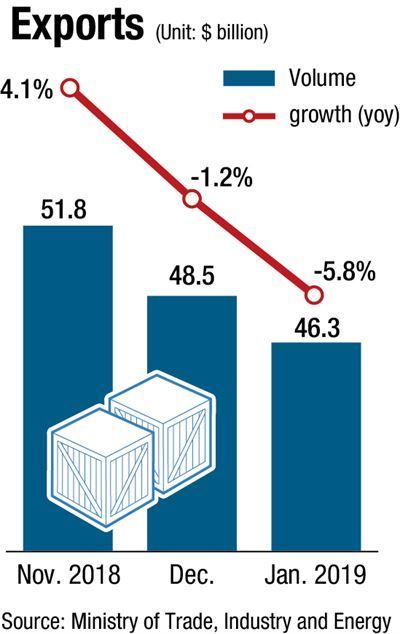
Exports fell 1.2 percent in December from the same period a year ago, and dropped a further 5.8 percent in January. Also, they are highly likely to continue to slide in February given the Lunar New Year holiday, according to the two ministries.
The falls in total exports in December and January, attributed to the global slowdown, will further pose a downside risk to the economy, analysts say.
“The decline for two straight months heightens the risk. The ministries' measure is expected to cushion the inevitable slowdown this year,” said Kim Doo-un, an economist at KB Securities.
Semiconductor exports fell more than 23 percent in January, negatively affecting the overall data, given that they had accounted for 20 percent of total annual shipments. In 2018, exports of chips increased nearly 30 percent.
However, an industry down-cycle amid a decrease in memory chip prices due to oversupply has worsened Korea's overall export data.
Besides U.S. protectionism, China's slowdown, and policies aimed at strengthening its homemade technologies such as semiconductors and robotics, have weighed on Korea's tech shipments, the finance ministry noted.
“The fall in exports has been building up since the latter half of last year amid trade protectionism,” Hong told reporters after an economy-related ministerial meeting last week.
“We will come up with countermeasures in mid or late-February.”

gettyimagesbank
Hong added his ministry has also asked the Financial Services Commission (FSC) to devise measures enabling SMEs to secure bank loans backed by their account receivables.
This will be an extension to the FSC's earlier measures aimed at helping SMEs secure export financing backed by their plant equipment and patents as collateral.
Companies can normally receive payments by cashing in their account receivables three to six months after selling their goods to importers. Receivables are forms of payment made in certificates issued by importers' banks. They are recorded as assets in financial statements.
Mindful of this, the finance minister said this can reduce the risks of corporate loans being defaulted on.
“We have been listening to local parts suppliers whose businesses are driven by exports, and who have been asking us to consider loan plans accepting their receivables as collateral,” Hong said.
Korea's exports to China fell 19 percent in January. Shipments to China account for 27 percent of the total. In November, they fell 3 percent, and in December, 14 percent, according to the trade ministry.
The chip industry's operating profit will fall 38 percent this year, according to a report by the Woori Financial Research Institute. This will spill over into other industries such as chemicals, materials and equipment.