NPS decides to intervene in management of Hanjin KAL

Citizens walk past the Korean Air office in Jung-gu, downtown Seoul, Friday, when the National Pension Service decided to intervene into the management of Hanjin KAL, Korean Air's de-facto holding firm. Yonhap
By Nam Hyun-woo
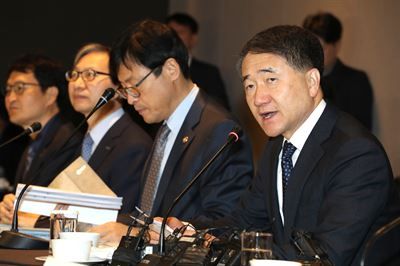
Minister of Health and Welfare Park Neung-hoo, right, speaks during a meeting of the National Pension Service's fund operating committee at the Plaza Hotel in Seoul, Friday. Park is the chairman of the committee. Yonhap.
The National Pension Service (NPS) will intervene in the management of Hajin KAL, Korean Air's de facto holding firm, its pension operating committee decided Friday. The move comes after the owner family of Hanjin Group caused public uproar over their alleged misbehaviors.
However, the committee did not exert its shareholders' rights directly on Korean Air because of the so-called 10 percent rule, requiring the fund to return short-term trading margins from the past six months to the firm.
The NPS is the third-largest shareholder of Hanjin KAL with a 7.34 percent stake, and the No. 2 in Korean Air with 11.56 percent.
It is the first time for the NPS to involve itself in an invested company's management, which became possible after the state-run pension fund applied its new stewardship code last July for enhanced shareholder activism.
Under the decision, the NPS will engage in Hanjin KAL's management at “a limited level,” by seeking a change in the firm's articles to allow sacking an executive who receives a sentence higher than imprisonment without labor for charges of embezzlement or breach of trust. The NPS intends to submit the plan during the company's shareholder meeting in March.
“For Hanjin KAL, we decided to exercise our shareholder rights at a minimal level,” Minister of Health and Welfare Park Neung-hoo said. He is the chairman of the committee.
Over the decision on Korean Air, Park said, “the purpose of the stewardship code is the fund's improved profitability,” citing the 10 percent rule, which may hamper the fund's profitability.
“We may have sacrificed our short-term trading margins and exercised active rights if the situation was worse than this, but we believe it is not at such a level,” he said.
The 10 percent rule is a financial act affecting shareholders with more than a 10 percent stake in a company. If they change the purpose of their share ownership from investment to engagement in management, they would have to return short-term trading margins from the past six months to the firm.
The NPS move came after a domestic activist firm acquired a significant stake in Hanjin KAL in November, targeting four Hanjin KAL directors' seats at the upcoming March shareholders meeting.
At the time, the NPS was picked as a key shareholder in the ownership battle, and the pension operator dropped hints earlier this month that it would exercise its rights against Hanjin KAL and Korean Air.
However, the move was followed by a backlash from experts concerning the government's excessive influence in the corporate world, given the 637 trillion won ($565 billion) fund has a stake larger than 5 percent in 297 companies including big names such as Samsung Electronics, SK hynix and POSCO.
“We are concerned that this decision may hamper Hanjin KAL's management practice,” a Hanjin Group official said. “If the NPS demands a change in the corporate articles at the shareholder meeting, we will discuss that at the board meeting in accordance with legal process.”
Businesses have expressed their concern over the NPS' decision.
“The decision has become a precedent of the NPS' engagement in corporate management,” Federation of Korean Industries executive director Bae Sang-geun said. “If the move expands and affects domestic businesses, it may discourage companies from corporate activities and hamper investment and job creation.”