Minimum wage controversy to continue in 2019
/By Lee Kyung-min
The Cabinet approved a revision bill whereby workers are eligible to receive an eight-hour wage every weekend for 40 hours of work that week.
The eight hours have become legally recognized working hours together with weekday working hours, which will be used to determine whether businesses are paying workers in accordance with the state-set minimum hourly wage requirement.
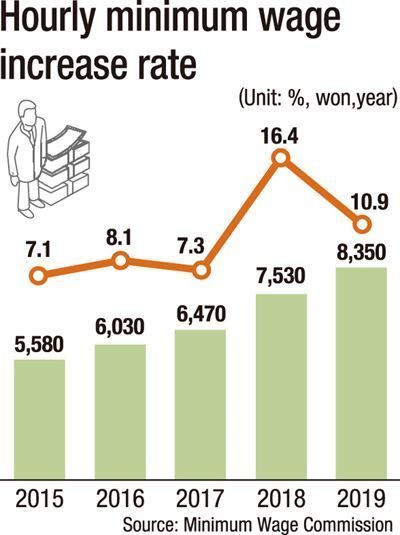
The minimum wage for 2019 is 8,350 won ($7.40), up 10.9 percent from 7,530 won in 2018, which was also a 16.4 percent increase from 6,470 won a year earlier.
Operators of businesses will be punished if the monthly payment divided by hours worked that month is less than 8,350 won.
More hours recognized as work provides grounds for the workers to demand higher wages, an enormous burden on employers, especially small- and medium-sized enterprises (SMEs).
They decried the government, saying the newly recognized eight hours are only pushing them toward bankruptcy.
“According a recent survey, about 30 percent of SMEs have been unable to pay workers due to the state-set minimum wage that increased rapidly to the point where we are forced out of our jobs,” Korea Federation of Micro Enterprise head Choi Seung-jae said.
“Given the situation, the newly recognized eight hours of paid work will only turn us into criminals. The government is continuing to railroad the issue which is life-and-death for us.”
They say this year's minimum wage will increase by 33 percent from 2018, given the “double whammy” of the minimum wage hike and the eight-hour paid rest.
The group said it will file a petition with the Constitutional Court seeking to nullify the move.
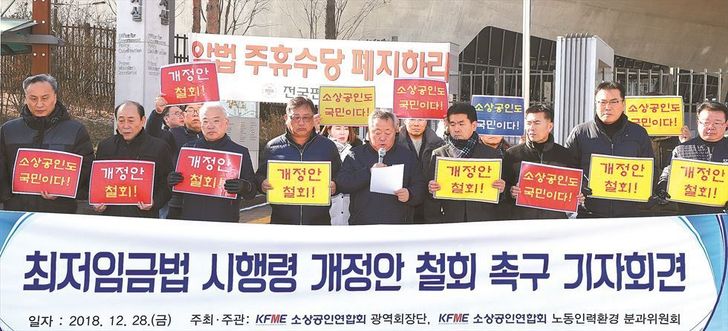
Self-employeed and small business owners protest against the revised calculation for the minimum wage in front of the Government Complex in Sejong, Friday. Yonhap
Similarly, petitions on Cheong Wa Dae's website have garnered tens of thousands of signatures demanding the government retract the newly recognized “bonus.”
However, the government maintains that no major changes are expected in the labor sector, given that the bill has been virtually in effect over the past three decades.
The only difference it says is the long-held practice is now officially stipulated in the law.
However, the move will pose a greater shock unless the government makes an immediate course correction on the minimum wage hike, according to an expert.
“While the government is right to claim the practice has long been in place, it continues to neglect that the rapid minimum wage hike over the past years has exacerbated the situation,” Yonsei University professor Sung Tae-yoon said.
“The government should revise the economic policy by first and foremost recognizing that employers are able to hire and pay their workers only when they make money. The minimum wage hike has resulted in an increase in layoffs and the shuttering of businesses. The ongoing controversy will continue over whether the government intervention in the private sector in the market economy is appropriate.”
Labor groups, however, still consider the recognition a “regression,” because it negates the minimum wage hike, making their income lower than prior to the hike.