Cracks appearing in banks' glass ceiling

Financial groups appoint more women to executive posts
By Lee Kyung-min
A growing number of Korea's major financial service firms have appointed women as CEOs or senior executives.
This is seen as a significant advancement inching closer to breaking the glass ceiling in the conservative industry long dominated by male-oriented culture.
On Dec. 21, Shinhan Financial Group nominated two women to fill senior executive positions in 2019 ― Wang Mi-hwa and Cho Kyoung-sun.
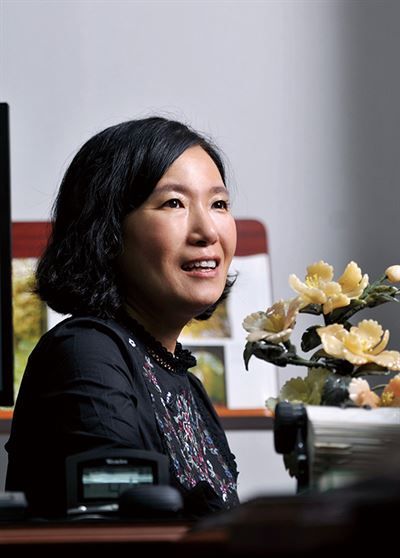
Park Jeong-rim at KB Securities
The nomination is in addition to that of former KB Financial Group and Kookmin Bank Vice President Park Jeong-rim, who was nominated Dec. 20 to head KB Securities as co-CEO.
The firm's general shareholders meeting approved the nomination the following day, making her the industry's first female CEO in the history of Korea's securities market since its launch in March 1956.
Shinhan with the two nominations is now able to shed its earlier image of not having a single female senior executive, a source of criticism that the firm long remained “indifferent” to gender equality.
In a quarterly reporting released in November from the country's four major banks ― KB Kookmin, Shinhan, KEB Hana and Woori ― out of 96 executives, only three were women. Shinhan had none while the others each had one.
Wang Mi-hwa at Shinhan Bank
Shinhan said the two women are well-versed in respective fields, with proven track records of detail-oriented, thorough work management and soft leadership.
Wang managed up to 200 billion won ($170 million) in customer wealth in 2006, posting annual yields of up to 60 percent, three years after she made a manager-level position at the bank.
Cho organized various programs through which both workers and customers built relationships, creating a workplace culture that was as comfortable as home. She received numerous awards for increasing worker productivity and satisfaction.

Cho Kyoung-sun at Shinhan Bank
They had their talents nurtured by “Shinhan SHeroes,” a tailored training and mentoring program launched in March under the direction of group chairman & CEO Cho Yong-byoung.
Through the program, female workers are encouraged to strengthen their network connections, share experiences with hardships and ways to boost self-motivation as well as reinforce leadership by setting themselves as role models for other women of less-privileged backgrounds.
Jung Jong-suk is currently the only female senior executive at Woori Bank. Serving as head of the Wealth Management Strategy Dept., she was promoted to executive vice president in November for her outstanding sales performance.
Korea International Financial Institute (KIFI) CEO Kim Sang-kyung, who doubles as chairwoman of the Korea Network of Women in Finance, said while the recent progress is heartening, far more women should be able to break the glass ceiling.
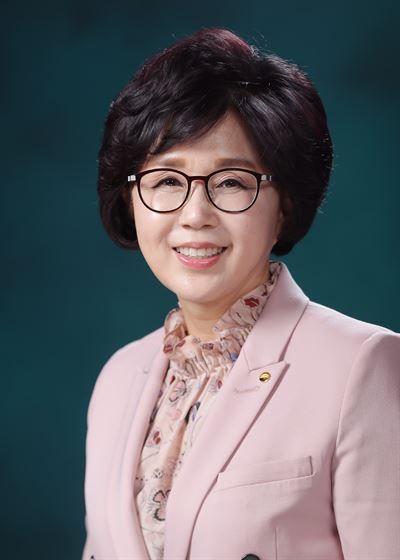
Jung Jong-suk at Woori Bank
“More women in the male-dominated workforce means more diversity, qualities that can increase competence and productivity. The recent appointment at Shinhan, while commendable, is long overdue. The financial services firms need to foster young women in order for them to reach their full potential,” she said.
Park's appointment is especially meaningful, given the widespread culture known to “exclude” women at the securities firms, Kim said.
“Prior to the appointment, Park had retained the bank's vice head position for six years, a significant achievement given most of her male counterparts do the same for less than three years. Her appointment deserves all the more accolades as securities firms are known to show greater reluctance to promote women to senior positions.”
Korea still has a long way to go to achieve gender equality, she added, saying a lack of female presence at the top executive level is not unusual in Korea.
According to data submitted Oct. 12 to Rep. Je Youn-kyung of the ruling Democratic Party of Korea from the Financial Supervisory Service, only 4 percent of executives at financial services firms in Korea between 2013 and 2017 were women.
At Mirae Asset Daewoo known for a relatively high number of female executives, only about 8 percent, or 18, are women out of the total 244 executives.