BOK raises key interest rate to 1.75%

By Lee Kyung-min
The Bank of Korea (BOK) raised its key interest rate by 25 basis points to 1.75 percent Friday in a bid to cool the housing market and forestall massive capital flight.
This is the first rate hike in a year since it increased the benchmark rate to 1.5 percent in November 2017.
In a 5-2 decision at the last monetary policy meeting of 2018, the board chaired by BOK Governor Lee Ju-yeol made the credit-tightening move, narrowing the gap between the Korea and the U.S. to 0.5 percentage points.
The U.S. Federal Reserve's rate remains at 2.25 percent.
At a media conference following the meeting, Lee said that despite lingering external and domestic uncertainties, Korea's economy is strong enough to weather the rate hike given low inflationary pressure and the continued, albeit meager, growth on the back of brisk exports and domestic consumption.
“Korea's economy in 2019 will likely be affected by a myriad of factors including the overall global economic slowdown, but consensus is that the economy will not contract any more significantly than earlier projected,” Lee said.
“The rate hike may stifle domestic consumption in the short them, but the real economy will not be affected too severely. The government's fiscal policy to reinvigorate the sluggish economy will also help.”
The much feared foreign capital outflow will not materialize any time soon, Lee added, citing stable and continued foreign investment in the country.
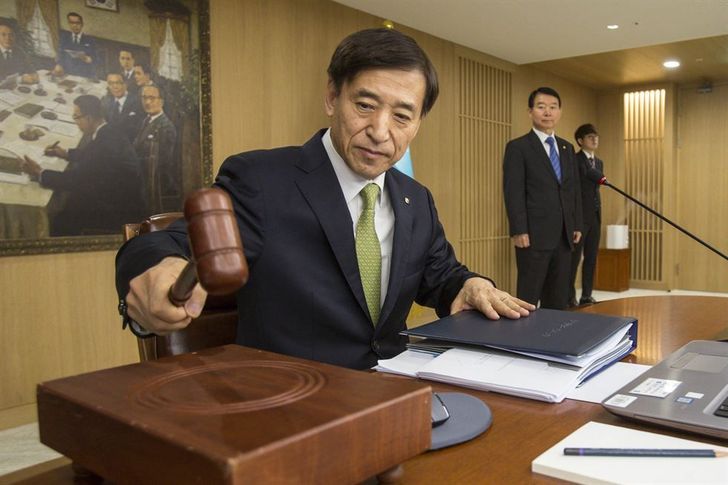
Bank of Korea (BOK) Governor Lee Ju-yeol bangs a gavel at a monetary policy committee meeting held at the BOK's head office in Seoul, Friday. / Yonhap
“No substantial foreign capital outflow has been detected while the rate gap between Korea and the U.S. remained at 75 basis points over the past year, an indication that foreign investors' assessment of a Korean economy with strong fundamentals is still vibrant. While there is no outflow-triggering figure, the continued widening in the rate gap is a concern. We are closely monitoring the market situation.”
Household debt is among the key economic indices the central bank watches with greatest attention as the indicator of a growing economic imbalance, he added.
“Factors under consideration include whether market liquidity flows only in a certain sector ― in the real estate market, for example ― or how investor sentiment on risk taking will be affected by the rate hike.”
The soaring household debt, now estimated at 1,514 trillion won ($1.3 trillion), is one of the most widely cited factors giving the BOK a reason to raise borrowing costs, as the low interest rate encouraged people to buy multiple homes to make capital gains, which has pushed up apartment prices.
Still below 'neutral level'
Lee said, despite the hike, the rate is still below the “neutral level,” a reason why the BOK deems the monetary policy still “expansionary and accommodative.”
“Following the global financial crisis, many countries developed a shared understanding that the neutral level has become lower in general.”
The BOK chief called for the government to carry out a more expansionary fiscal policy.
“The government's fiscal policy has not been expansionary thus far, but change is expected following its announcement to boost the economy in 2019. I hope the government will run fiscal policy in a way that boosts the country's growth potential.”
Lee said the country will likely see moderate layoffs in the short term, mostly affecting minimum wage earners at small- to medium-sized firms, but the crucial process will help streamline the country's financial stability in the long run.
“Corporate restructuring to boost labor productivity and remove inefficiency is a task that should be pursued regardless of economic conditions. It is the government's role to establish a social safety net to minimize the fallout to the ordinary people following sudden layoffs.”
Experts said that the rate increase could weigh on low-income households and small businesses as it could lead to hikes in commercial banks' lending rates.
They pointed out that it was an inevitable choice for the BOK not to lose trust in the market, given the central bank had sent multiple signals.
“The BOK has followed through on its earlier signals despite the current market condition which is far from conducive to a rate hike,” said Sung Tae-yoon, an economist at Yonsei University.
“And it will have to pay closer attention from now on to other developments that entail from the rate hike.”