Consumer sentiment falls to 21-month low in Nov.
By Lee Kyung-min
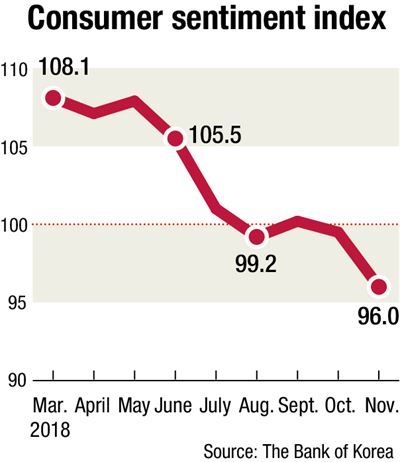
Korea's consumer confidence fell to the lowest level in 21 months in November due to worsening economic data and volatile financial markets.
This means that the nation's economy, already beset by sagging investment and a worsening job market, is highly likely to undergo further slowdown.
According to a survey released by the Bank of Korea (BOK) Tuesday, the composite consumer sentiment index (CCSI) for November came to 96, down 3.5 points from a month ago.
It was the second consecutive month the index stayed below the benchmark 100 and the lowest level since February, 2017 when it stood at 93.9. A reading below 100 means pessimists outnumber optimists.
The result came from the central bank's poll of 2,188 households across the nation conducted from Nov. 12-19
The BOK said that consumers' confidence has been deteriorating due to fears of further economic downturn over a mixture of multiple negatives.
They include the ongoing U.S.-China trade dispute, weak job data, recent stock market tanking, rising daily necessity prices, all of which are further worsened by “income-led growth,” the failing signature policy of President Moon Jae-in.
“The ongoing trade dispute between the world's two largest economies continues to weigh down on Korea, the export-reliant economies vulnerable to external shocks. Also taking a toll on consumer sentiment is job data and stock market rout,” the BOK said.
A sub-index measuring consumer sentiment on current living standards and future outlook both dropped by 1 point each to 90 from the previous month.
The index also showed the consumer sentiment on current household income and future household spending slid to 97 and 108, two and three points lower than the month before, respectively.
Also gloomy was their sentiment on the current and future domestic economic conditions, both of which slid five points to 62 and 72 respectively.
“All indices showed the country's economy is headed for the worst,” said Lee Chae-woong, a professor emeritus of economics at Sungkyunkwan University.
“The external factors will continue to weigh down on Korea, and if the BOK raises the interest rate Nov. 30, the living standard of Korean people will further deteriorate.”
The worsening consumer sentiment is largely echoed by a group of certified public accountants (CPAs).
A business survey index (BSI) of 300 CPAs in October conducted by the Korea Institute of Certified Public Accountants showed the reading stood at 64 for the second half of 2018 while that of the first half of 2019 stood at 69.
Sectors that continue to and will remain strong for 2019 include bio, pharmaceutical, electronics, oil refiners, and IT firms, indicated by the above-100 BSI readings.
By contrast, carmakers, shipbuilders, steelmakers and builders continue and will remain sluggish, indicated by readings between 40 and 58.