Insurers set to hike auto premiums by 3%
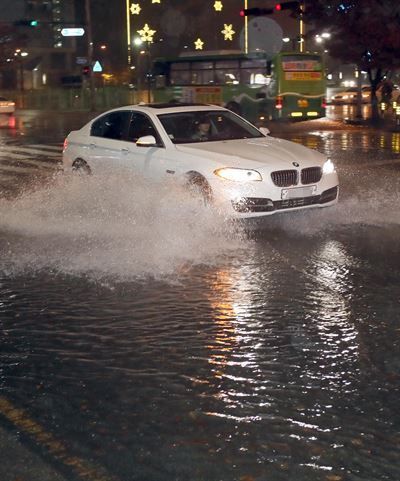
A car drives in a flooded street after a heavy downpour hit Busan, Nov. 8. Insurance companies say a hike of at least 3 percent in auto premiums is inevitable due to a surge in maintenance and repair fees after a heat wave followed by heavy rain over the past few months. Yonhap
By Lee Kyung-min
Insurance companies are moving to raise auto premiums by at least 3 percent by the end of 2018 amid soaring maintenance and repair fees.
Meritz Fire & Marine Insurance, the country's sixth-largest insurance firm with 1 million policyholders, asked the Korea Insurance Development Institute (KIDI) to review the premium increase plan.
“We are under growing pressure to increase the rate as all auto insurance companies are. All of us have suffered losses due to intensified competition over lower premiums last year,” an official from the firm said.
“The KIDI assessment will be out in about two or three weeks. We will take the findings into consideration, although we have not decided whether to push forward with the increase or how much it will be.”
The request filed by the industry's relatively mid-tier player with a 5 percent market share is likely to be followed by the big four non-life insurance firms ― Samsung Fire & Marine, Hyundai Marine & Fire, DB Insurance and KB, which are also considering a 3 percent hike.
The big four account for about 80 percent of the market share.
Mid-tier Lotte, Heungkuk Fire & Marine and AXA General are also expected to join the move.
“All firms have similar concerns because of the heated competition-induced lower premiums last year, compounded by the rapid minimum hourly wage increase,” an official from one of the big four firms said on condition of anonymity.
“With the lowered insurance premium, if the number of car accidents and the resulting coverage cost remains about the same or worse yet increases, it is a perfect recipe for us to see our business go in the red,” the official said.
While the collective move reflects multiple cost-raising factors, the largest culprit was the increased cost of car repairs over the past few months when Korea experienced a record-breaking heat wave and heavy downpours, they noted.
The adverse conditions all translated into a rising loss rate ― the rate of insurance money paid to subscribers from companies' premium income.
Firms say about 80 percent of the loss rate is the bottom line for the insurers to help their business stay afloat, with a higher number meaning a decreased profit margin.
Calls for the increase are expected to gain momentum following a report from the Financial Supervisory Service (FSS) Monday showing that the country's 11 non-life insurers posted an average loss rate of 83.7 percent as of the third quarter of 2018, compared with 78.9 percent a year earlier.
The FSS said the firms posted a combined 210.4 billion won ($184.7 million) in operating losses over the first nine months in 2018, compared with 243.7 billion won operating profit recorded a year earlier.