Economy expected to worsen further in 2019
By Lee Kyung-min
The Korean economy is expected to deteriorate further in 2019 amid lingering global uncertainties coupled with domestic woes, said a group of noted authors of new book “2019 Economic Issues & Trends,” Tuesday.
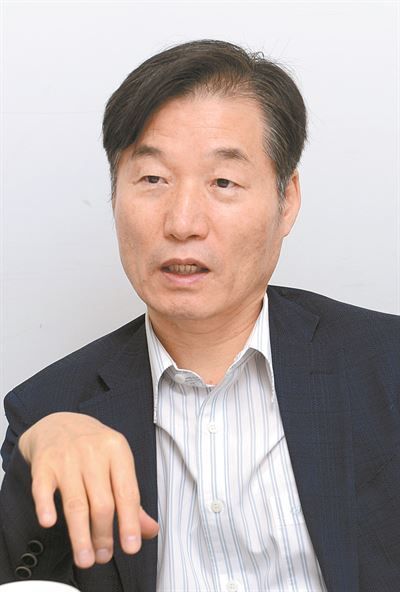
Lee Keun / Korea Times file
They forecast that Asia's fourth largest economy will be bogged down by the ongoing, hegemony-oriented trade tension between the U.S. and China, further compounded by what they dubbed a “fiscal trilemma,” a situation where the government has no optimal solution to adequately manage three key components to “good governance” ― high-quality welfare, low tax and low government debt.
“The trade tension will not subside any time soon. This is not a simple conflict, but rather a new Cold War,” said Lee Keun, a Seoul National University Economics professor, at the press meeting in Gwanghwamun Seoul.
“The world is increasingly moving toward protectionism with shrinking free trade. Korea, which achieved success primarily due to stable democracy and free trade thus far, is inevitably bound to suffer consequences due to no fault of their own in the coming years,” said Lee, who doubles as a director at the Center for Economic Catch-up.
The fiscal trilemma, for which the government has no silver bullet, is a key issue for policymakers to consider before determining the future course of the country, he noted.
For Korea to follow the path of the Swedish model, a substantial tax increase is inevitable to guarantee high-quality welfare system.
If the country emulates the Japanese model, whereby high-quality welfare is guaranteed with relatively low tax, the government will incur massive amount of debt.
“Should the government prioritize two of the three components, it should be ready to take criticism concerning the remaining one, which is in no way an easy task. Public discussion should precede before policy implementation to form a shared understanding to limit blowback afterwards,” Lee said.
Foreign capital outflow can very well become a reality, following a possible increase in central bank key interest rate, he added.
The much-feared scenario has been avoided thus far because the expectation on foreign “exchange gain,” following appreciation of Korea's currency (won) on the back of overseas sales surplus, has largely offset the fear on an interest rate gap between the two countries.
However, if the U.S. Federal Reserve raises the interest rate 25 basis points again, widening the gap between Korea and the U.S. to 1 percentage point, the scenario could become a harsh reality, not to mention what other external shock would play into the unpredictable picture.
“In 2008, the global financial crisis occurred in the U.S., an advanced economy. At the time, Korea, which had no direct role in the financial meltdown, had to see foreign capital flee, leading to the value of won falling to 1,500 won against the greenback. No one can accurately predict the future but we should be well prepared to when the risk arrives,” Lee said.

Ryu Deock-hyun / Korea Times file
Ryu Deock-hyun, an economics professor at Chung-Ang University, echoed the Lee's view, saying if the rate gap widens to 1 percentage point, Korea's economy will be hit hard.
“Household debt and real estate issues will all suffer the consequences of global uncertainties. While the U.S. economic indicators are relatively stable, the uncertainties will grow further depending on the outcome of the U.S. mid-term election,” he added.
The authors agreed on the need to modify President Moon Jae-in administration's iconic “income-led growth” policy.
Lee requires prompt review as a rapid hike of the hourly minimum wage entailed protests from the country's small- and medium-sized enterprises, which in turn resulted in a steep cut in the employment, hence the woeful job data.