Fear of foreign capital exodus growing
KOSPI falls to yearly-low of 2,106.1 on weakening won
By Jhoo Dong-chan
Concerns are mounting over massive foreign capital flight as foreigners are rushing to dump Korean stocks and bonds sending a shudder through the Seoul financial markets.
2018-10-23(코리아타임스)
The benchmark KOSPI fell sharply to a yearly low of 2,106.1 Tuesday, down 55.61 points or 2.57 percent from the previous close, on the back of a foreign selling spree in the wake of the overnight fall in the U.S. stock market and weakening Korean won.
On Tuesday, foreigners continued their selling streak for the fourth consecutive day dumping over 400 billion won worth of shares.
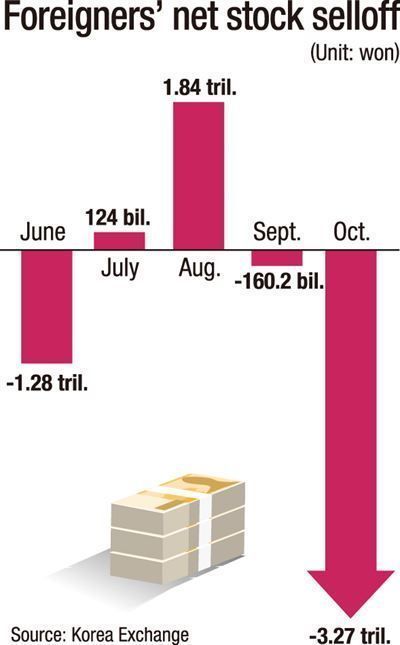
According to the Korea Exchange (KRX), foreign investors have already dumped nearly 4 trillion won ($3.54 billion) worth of assets this month.
They recorded around 3 trillion won worth of net sales on the Seoul bourse between Oct. 1 and 23. They also sold over 1.3 trillion won worth of bonds during the same period.
Analysts said that the foreign selloff has been driven by lingering uncertainties caused by the U.S.-China trade tension coupled with the interest rate gap between the United States and Korea.
But the key trigger for the selloff over the past month is the depreciation of the Korean won against the dollar, which has reduced currency gains for foreign investors.
Despite the U.S. rate hikes, foreign investors have invested in Korean stocks and bonds as foreign exchange gains more than offset losses stemming from the widening interest rate gap.
Due to the U.S. Federal Reserve's hawkish stance on the benchmark rate, the won-dollar exchange rate stood at 1,137.6 won Tuesday, up 9.2 won from the previous close. This is around an 8 percent rise from the year's low of 1,054 won, April 6.
The gap between the U.S. and Korea's policy rate has remained at 0.75 percentage points since the Bank of Korea (BOK) decided to keep its key rate untouched at 1.5 percent during its Monetary Policy Board meeting, Oct. 18.
The central bank held its accommodative stance highlighting deteriorating investor confidence and the worsening job market in Korea, but market observers are now concerned that the BOK's “wait-and-see” approach could induce a massive foreign selloff at the end of the year.
Experts said the weakening won accompanied with the scheduled U.S. interest rate hike next year are reasons behind the ongoing foreign selloff.
Taurus Investment & Securities researcher Jeon Sang-yong expects that external factors will determine whether the foreign selloff will continue through the end of the year.
“The authorities have successfully managed the nation's external debts, but we are not in the safety zone from a massive capital outflow,” he said in a recent press release.
“We will see a certain degree of capital outflow if the gap between the U.S. and Korea's interest rate stretches to 1 percentage point.”
However, Korea Institute of Finance President Sohn Sang-ho dismissed such concerns, saying that the Korean market will not be swayed unless the gap widens to over 1 percentage point.
“The key rate isn't the decisive factor behind the nation's weak stock market. Korea can withstand shocks from an up to 1 percentage point gap in the key rate,” he said.
“The foreigners' selloff was rather attributed to firms' deteriorating figures for the third quarter of the year. Except chipmakers, local firms saw disappointing numbers in export markets.”
Meritz Securities analyst Yoon Yeo-sam agreed.
“If Korea manages to maintain its trade surplus at the current level, it is very unlikely to see a massive capital outflow in the near future,” he said.
“I believe the BOK will raise the key rate in November. But unless foreigners suddenly dump their bonds and stocks because of the widening gap, the central bank does not need to rush for a rate hike even in November.
BOK Governor Lee Ju-yeol also stressed his confidence.
“The nation's financial soundness is still stable,” Lee said after the BOK Monetary Policy Board meeting, Oct. 18.
“Foreign investment in the nation's bonds is mostly from public sector centered on the long-term. I believe such fear of a massive capital outflow is groundless.”