Corporate investment falls for 5th straight month
Companies reluctant to invest on unfriendly biz policies
By Park Hyong-ki
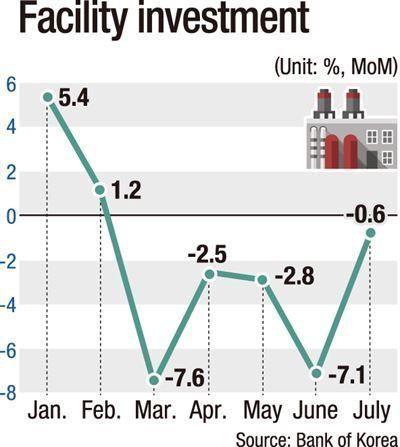
Private sector investments in equipment for the expansion of plants fell 0.6 percent in July from the month before, according to state-run Statistics Korea, Friday.
The country's facility investments have declined for five straight months. This marks the longest downturn in 20 years.
The decline in July was mainly due to the semiconductor industry reducing its investments as it is undergoing adjustments and corrections following its peak, the statistical agency said.
“The industry has reached a stage where it has fulfilled its investment plans. That is why its facility investments fell,” said Eo Woon-sun of Statistics Korea's industry statistics.
Semiconductors have been driving the country's exports, accounting for 20 percent of the total outbound shipments.
The poor facility investment data follows a recent series of key indices including consumer and business sentiment showing weak figures. The business sentiment index fell 1 point to 74 for August. It has been falling since June this year when the index stood at 80, according to the Bank of Korea (BOK).
Analysts say the country is unlikely see an investment rebound in the near future, given businesses are trying to “play safe and be cautious” as the government seeks to further push its pro-labor policy.
“It would be difficult to see a complete reversal of circumstances as businesses remain reluctant and cautious to invest during current conditions,” said Yun Chang-hyun, an economist at the University of Seoul.
Basically, players and their coach ― the government ― are not moving in tandem as the current environment remains unfavorable to those players for doing business in the free market.
Businesses are tightening their spending as they are not getting “the motivation” needed to move forward from the government, which is seemingly moving in the opposite direction, Yun added.
Its expansionary fiscal plan is not likely to work as long as the government keeps adhering to a one-sided policy that only focuses on increasing wages.
Yun, a former president of the Korea Institute of Finance, said the country's monetary policymakers cannot help turn the tide.
“There is not much the central bank can do at this point. It is mostly playing a passive role by following the U.S. Federal Reserve's rate policy,” he said.
“The BOK will not be able to lower its rate for the economy while the Fed is considering rate hikes.”
Analysts say the 0.6 percent decrease is the beginning of a longer period of falling investment.
Semiconductors, the country's only hope for growth, is about to slow down after reaching the end of the bubble.
And an index projecting the country's future economic cycle has fallen below the 100 threshold, which means the economy is expected to further slow down. The composite leading indicator (CLI) fell to 99.8 in July, down 0.2 points from 100 in June. It has been sliding since March this year.
“This has serious implications as the economy could face a downcycle,” said Kim Doo-un, an economist at KB Securities.