Schindler vs. Hyundai case to test Korea Inc.'s global credibility
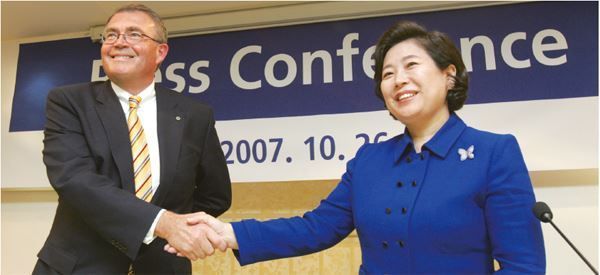
Hyundai Group Chairwoman Hyun Jeong-eun and Alfred Schindler shake hands at a media conference in Seoul on Oct. 26 2007. / Yonhap
By Jung Min-ho
Korea's family-run conglomerates, or chaebol, are infamous for their web-like ownership structure, which makes it possible for the founding families to control business empires with only a small stake.
If necessary, they also use group affiliates as a means of tightening their grip by, for example, moving money from one unit to another in the guise of “business contracts.”
This is what scares many foreign investors: competitiveness in the market and the economic situation may not be the most important factors that determine a company's future.
“Good performers can still lose money because of such a shady business practice that helps founding families at the expense of shareholders,” a source familiar with Schindler told The Korea Times this month. “Korea needs to stop it now. Change is overdue.”
Schindler, a Swiss-based manufacturer of elevators and escalators, decided to invest in Korean elevator maker Hyundai Elevator in the early 2000s when Korea was still reeling from the 1997-98 Asian financial crisis.
In 2007, Hyundai Group Chairwoman Hyun Jeong-eun invited Alfred Schindler, the chairman of Schindler Holdings at that time, and his wife here to announce their strategic partnership.
Schindler thought Hyundai Elevator's prospects were bright, given its technology and other market factors. But Schindler did not know that Hyun had enormous power, which allowed her even to make decisions that would hurt the interests of most shareholders, the source noted.
It was the period when Hyundai Group was divided among its late founder Chung Ju-yung's sons following the financial crisis.
To strengthen her control over the group, Hyun allegedly used Hyundai Elevator's money to prop up its struggling sister company Hyundai Merchant Marine, the key in her control chain, through loss-making derivative contracts and capital increases over several years.
Schindler, now Hyundai Elevator's No. 2 shareholder, claims the company has lost about 1 trillion won ($880 million) in the process.
“What if Hyundai Elevator invested that money for its future? It would have grown into a far more competitive and larger company by now,” the source said.
Schindler is demanding current and former Hyundai Elevator directors compensate the company for damages in a derivative lawsuit. After losing the case in 2016, Schindler appealed to the Seoul High Court.
Separately, Schindler has sent a petition to Korean President Moon Jae-in because it believes the government failed to provide the proper protection it promised. This came after Schindler filed the same complaints to the Financial Supervisory Service and the Financial Services Commission.
Schindler urges the government to engage in the issue as a fair arbitrator to resolve it amicably. If not, the company said it would bring the case to the International Centre for Settlement of Investment Disputes.
A Hyundai Group spokesman said Hyundai Elevator did not violate any laws in the process of making derivative contracts with other Hyundai affiliates and issuing new stock to increase capital against some shareholders' wishes.
The government has tried to boost foreign investment, promising a fair and credible system. But without improving corporate governance, the country is expected to continue to scare off “good investors” while only attracting opportunists, experts say.
“Legalities aside, such business practices are clearly a negative factor in terms of attracting foreign investors, especially those who come here for long-term investments,” said Ryou Hyo-sang, a business professor at CHA University. “Such practices may have been acceptable in the past, but they do not meet current global standards.”
Amid growing competition for foreign investment, Ryou advises the government to put more effort into making a more reliable and predictable investment climate.