'Gaining trust is essential for blockchain networks'
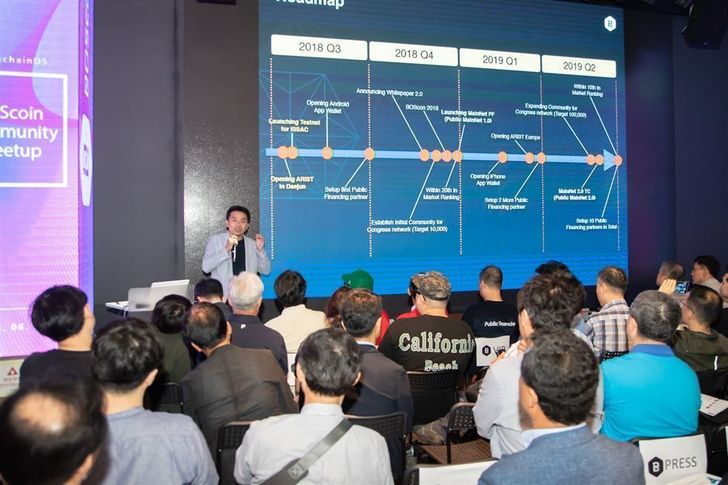
BOSCoin CEO Yezune Choi explains how his company's blockchain platform actually works in a meeting with local and foreign investors held in Gangnam, southern Seoul, last week. Courtesy of M&K PR
By Kim Yoo-chul
For blockchain, opening the “source code” is essential to building trust and safety in its networks.
Google started the Android Open Source Project in response to its own experience in introducing mobile applications, as it wanted to make sure there would always be an open platform available for third-party developers to make new and innovative ideas a reality.
Similarly, the code each open blockchain project is developed for open source software. Interested parties are allowed to join open networks and open source software aligns their incentives toward cooperation.
Eric S. Raymond, the author of “The Cathedral and the Bazaar,” described how open source represents an evolutionary mode of tech production. Linux exemplifies the open source model and now cryptocurrencies are following this model as well; but BOSCoin, a local blockchain platform focused on project financing, is apparently looking for more.
“If the code isn't open source, how will participants ever be able to understand and trust the system they are participating in? To make our blockchain system make sense, the TestNet source code, which is a preset for BOSNet, is available on communities,” CEO Yezune Choi said recently.
He said TestNet has been optimized for public financing. As the upcoming BOSNet platform is backed by ISAAC, which it claims as an in-house consensus protocol, its main platform ensures data protection _ “safely and efficiently.”
ISAAC is a short for Initial vote, Sign, Accept, and All-Confirm, which BOSCoin says is a protocol used in public financing processes.
“Open source is produced, shared freely and published transparently and developed to be a community good. This decentralization in technology production has lots of solid benefits and can be difficult to grasp for those not familiar with the move,” the executive said.
BOSCoin plans to open up its main platform BOSNet in the fourth quarter of the year.
“The single most important goal of the trial test is to make sure the BOSNet platform is implemented as widely and precisely as possible to investors' benefit,” Choi said.
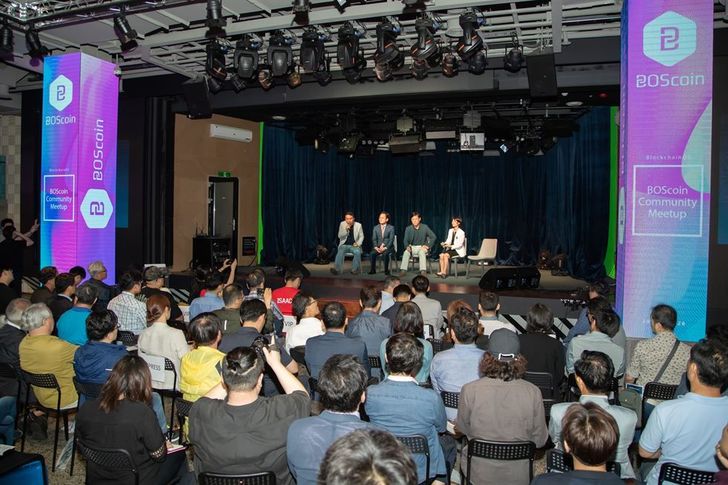
Investors participate in a panel discussion at the BOSCoin Community Meetup held in Gangnam, southern Seoul, last week. Courtesy of M&K PR
Launching “reverse ICO” program with partners
The amount of money created from initial coin offerings (ICOs) of blockchain-based companies is surprising. While Korea, home to three of the world's top 15 cryptocurrency exchanges, still bans ICOs, the growing numbers are impressive.
Yet, on the horizon is a potentially even greater wave of ICOs, or “reverse ICOs,” where existing businesses realize the best way to compete is by decentralizing themselves, according to analysts and industry experts.
Additionally, reverse ICOs are a tool for established businesses to raise funds and get into cryptocurrencies. It's a regular ICO as only the reverse part is changing the business model from centralized and fiat-based to decentralized and cryptocurrency-based.
Choi believes getting more partners for financing projects on the BOSNet platform via its Reverse ICO Partner Program will be beneficial as that type of ICO will help it decentralize its infrastructure with a cryptocurrency. This puts BOSCoin in a better position to be part of the new “token” economy.
In a statement, BOSCoin said the doors are open for applicants to join the ICO partnership program. Winners selected from its own screening process will be given an additional 500 million won ($450,000) if they raise 500 million won from the pre-ICO stage.
“Winners will be provided with extra technical consultations. After ICOs, their businesses will be put on the BOSNet platform to help them receive additional funding through public financing projects,” the statement said.
“The development of the BOSNet platform is on track as scheduled. We will cooperate with reverse ICO companies even from the pre-ICO stage and support them to further develop their business models that will be operational within our blockchain system.”