Voices growing against minimum wage hike
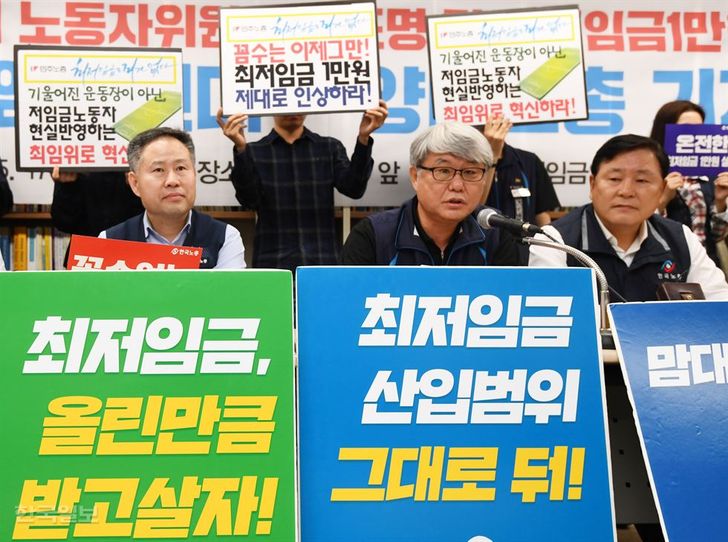
Representatives of the country's leading umbrella unions demand raising the minimum wage as planned at a media briefing held in downtown Seoul, last week. / Korea Times photo by Hong In-ki
By Yoon Ja-young
The Moon Jae-in administration's plan to steeply raise the minimum wage is facing hurdles as voices opposing the plan are gaining momentum.
The minimum wage committee started discussion for the 2019 minimum wage last week. It has to come up with its determination within two months.
During this short period of time, the committee has to analyze how the steep minimum wage hike affected workers' incomes and businesses as well as the job market.
The country's hourly minimum wage is set at 7,530 won this year, following a 16.4 percent hike. It is scheduled to continue the steep rise since President Moon Jae-in has pledged to raise it to 10,000 won by 2020, under the income-led economic growth strategy in which increased income of the working class will pull up consumption and boost the economy. To achieve the 10,000 won target, it should be raised by 15.24 percent for two consecutive years.
However, there has been increasing concern over the steep hike as job market conditions have been worsening.
The number of newly added jobs stood at 123,000 in April, which is a mere one third of the 420,000 recorded a year ago. Jobs in industries heavily affected by the minimum wage, or wholesale and retail as well as restaurant and lodging, dipped 88,000 from a year ago. Experts point out that businesses such as convenience stores, restaurants and lodgings have already been decreasing their hiring following the approval of the minimum wage hike last year.
Strategy and finance minister Kim dong-yeon also admitted the possible negative impact on the job market.
“Based on experience or intuition, I think the minimum wage hike would have affected employment or wages,” he told lawmakers last week. The remark drew attention as the government had been only reiterating that the effect of the minimum wage hike on the job market was not clear. Those who are supportive of the minimum wage hike say the current sluggish job market has to do with corporate restructuring in key industries such as shipbuilding and automobiles. However, the labor ministry is also becoming cautious. “The 10,000 won minimum wage should be attained, but we are currently cautious about achieving it by 2020,” vice labor minister Yi Sung-ki said in a recent briefing.
SMEs and merchants have been demanding that the regular bonus and other allowances should also be included in the minimum wage to prevent a steep hike.
Amid growing pressure, the lawmakers of the environment and labor committee of the National Assembly discussed Monday whether bonuses and other allowances should be included when calculating the minimum wage, but they failed to reach consensus.
The labor unions have been strongly opposing such a move, pointing out that it will nullify the effect of the minimum wage hike. The Korea Confederation of Trade Unions said that it will not participate in the tripartite meeting of labor, management and government to protest such a discussion at the National Assembly. The umbrella union has been demanding that the scope of the minimum wage should be determined in the minimum wage committee which includes representatives of labor.
Korea Employers' Federation requests that the minimum wage should differ between industries and regions.
“There is a huge gap according to industries and regions, in terms of labor intensity, living expenses and the capacity of businesses to pay workers. It is irrational to apply a single minimum wage to all industries and regions despite such gap,” it noted in an announcement.