Bank of Korea bracing for volatile financial market
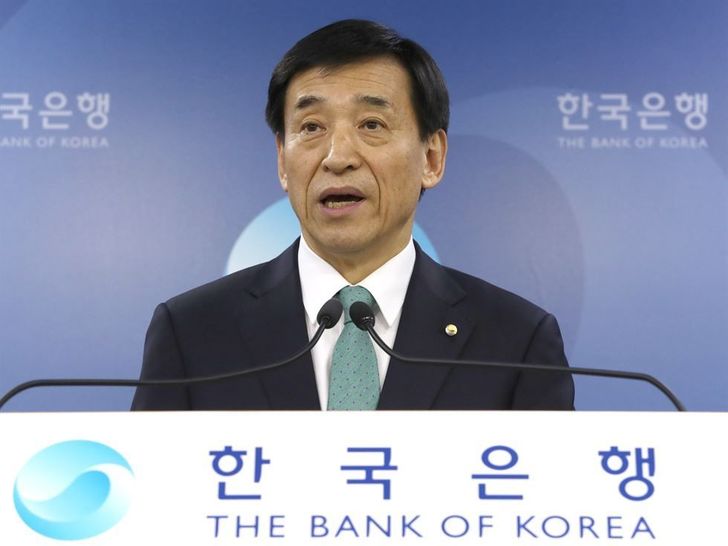
Bank of Korea Governor Lee Ju-yeol responds to a question after the country's central bank left its benchmark key rate unchanged in April this year. Yonhap
By Kim Yoo-chul
Emerging economies can “effectively navigate” any turbulence from a tightening of U.S. monetary policy as this will not produce capital outflows. The Bank of Korea (BOK) is also looking for any increased volatility in financial markets to anticipate any changes.
The BOK plans to continue its “gradual push” towards higher interest rates despite investors betting against emerging markets amid concerns about the U.S. Federal Reserve's policy.
“Inflation is under control within the bank's earlier target and the bank doesn't need to tighten its monetary policy,” Cho Dong-chul of the bank's monetary policy committee said in a news conference Wednesday.
Cho said the fundamentals of the economy were in good shape. As conditions vary country by country, inflation, current account balance and real rate differential were “good enough” for Asia's fourth-largest economy to minimize risks from global financial instability, he added.
“Core consumer prices, which exclude volatile agricultural and oil products, increased 1.4 percent in April from 1.3 percent in March and 1.1 percent in January. The level is still low because demand-side inflationary pressure is low,” Cho told reporters, indicating the bank is unlikely to raise its benchmark rate given that there is no inflationary pressure.
Fed Chairman Jerome Powell said, “there is good reason to think the normalization of monetary policy in advanced economies should continue to prove manageable for EMEs,” adding any decision to increase the benchmark rate will have little impact on global financial conditions. BOK officials said the bank was monitoring the soaring U.S. dollar and how it will affect the domestic economy.
The BOK said investment by Korean investors into emerging market currencies and securities excluding the dollar, Japanese yen, Chinese yuan, British pound and Hong Kong dollar rose to $43.4 billion last year from $20.5 billion in 2012.
The International Monetary Fund warned last month that risks to global financial stability have increased over the past six months, while the BOK said it will respond with interest rate hikes corresponding to the Fed but only if a “sell-off intensifies.”
“Any risks in emerging economies would bring losses to domestic investors who invested in assets in those economies looking for higher returns. Also, financial institutions in Korea may struggle when they sell U.S. dollars in the money markets,” said an official.
Debt sales from countries such as Russia and Argentina have been canceled or postponed recently as potential buyers balked at the prospect of inflation and widening budget deficits.
Argentina's central bank raised its rates three times to 40 percent. Russia has put the brakes on further monetary easing, while Turkey is planning to bring down its current account deficit. Indonesia is burning its reserves to artificially increase its currency value, according to reports.
Economists say those most vulnerable to rising oil prices, the Fed's rate hike and protectionism include Ukraine, China, Argentina, South Africa and Turkey.
The Institute for International Finance said overall buffers in addressing increased market volatility are stronger today than five years ago when the Feb triggered panic selling by signaling a taper of its big stimulus program. Also, alternative tools developed since the last crisis such as macro-prudential buffers, allowing central banks a broader set of options than just rate hikes.
“Korea is an open economy. Still, it looked like all macro-economic indices are dependent upon developments of U.S. financial markets with little contribution for domestic issues. But the BOK found that Korea's economic cycle is strongly influenced by global factors,” Cho said.