Samsung ordered to change byzantine ownership
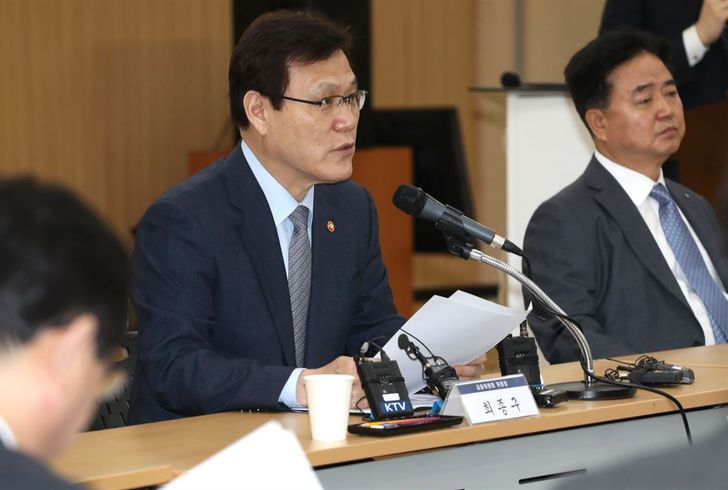
Financial Services Commission Chairman Choi Jong-ku makes comments while holding a meeting with executives of the domestic life insurance industry in Yeouido, Seoul, Monday. Yonhap
By Kim Yoo-chul
Samsung Group is coming under increasing pressure to overhaul its web-like corporate structure, with the country's top financial regulator officially pushing the corporation to simplify its cross-holdings system.
“The Financial Services Commission (FSC) wants Samsung Life Insurance (Samsung Life) to voluntarily prepare relevant measures to unload its holdings of Samsung Electronics before the legislation of related law is passed,” FSC chief Choi Jong-ku told reporters Monday.
The senior government official added the “Samsung Life-Samsung Electronics issue” is the central point about the debates over the conglomerate's governance structure.
“If Samsung expects to be 'freed' from controversy about its governance, then it has to show its willingness and commitment to address it,” Choi told reporters, saying the financial regulator was in talks with relevant government agencies to protect investors from upcoming action(s).
This is the first time for an FSC head Choi to directly mention Samsung and urge it “do something” to comply with the government initiative.
While Samsung's life insurance unit isn't the best-known part of the Samsung conglomerate, unlike Samsung Electronics, it does play a crucial role in the elaboration system of circular ownership that Samsung's Lee family uses to maintain control over the entire group.
Because the ownership structure of the whole of Samsung is highly-complicated with some circular ownership within the affiliates, the decision by Samsung Life to sell its stake in Samsung Electronics is seen as “another meaningful step” to revamp the Samsung ownership structure for which its de facto leader Lee Jae-yong received a suspended jail term.
What Samsung does is a bit more complicated because each affiliate owns a stake in another one. “A” affiliate owns a stake in “B.” B owns a stake in “C” and C in A. The cross-shareholding structure, which tends to lock up control among long-standing fellow firms or business partners in a conglomerate, is common in Korea, also in Japan.
Under the law, financial units affiliated with conglomerates are prohibited to own stakes in non-financial units by more than 10 percent. Samsung Life is the largest shareholder of Samsung Electronics with the former having an 8.2 percent share in the group's most-well known affiliate.
“Despite repeated warnings to change its ownership structure, so far, there has been no substantial progress. Again, our message is clear and simple ― please do think about it. If not, we may step in,” he said.
“Samsung Life's combined share in Samsung Electronics and Samsung Fire is expected to go over 10 percent by the end of this year after measures by Samsung Electronics to boost shareholders' value,” said one Samsung official, adding Samsung's next plan to hand over the additions to Samsung C&T, the second largest stakeholder in Samsung Life, is expected to be put on hold due to the latest requests by the FSC.
The monetary value of the Samsung Life-owned 8.2 percent stake in Samsung Electronics was estimated at 27.2 trillion won, given Samsung Electronics' total assets by last week of 331.3 trillion won.
On a related note, the head of the country's top anti-trust regulator, Kim Sang-jo, said the agency expects “lots of changes” in Samsung's governance structure. The fair trade commission chief Kim said he's been satisfied to see announcements by Hyundai Motor Group, Korea's No. 2 conglomerate controlled by the Chung families, of which the conglomerate pledged to streamline its ownership structure.