Women's tennis champion turns into bank teller
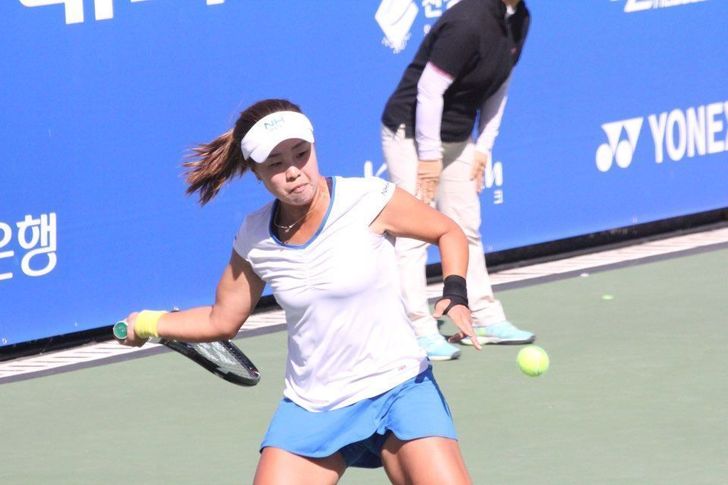
Lee Ye-ra returns a shot during a tournament in 2015. / Courtesy of Lee Ye-ra
By Nam Hyun-woo

Lee Ye-ra at her NH NongHyup Bank branch in Chuncheon, Gangwon Province. / Courtesy of Lee Ye-ra
For many athletes, life after quitting their sport has always been an issue. While some opt to continue on the sidelines as a coach or manager, others go for a whole new chapter in their life.
Lee Ye-ra, who has represented Korea in women’s tennis at three consecutive Asian Games since 2006, is one of the latter.
After spending a trophy-studded career in the sport for more than two decades, the 30-year-old has been working as a clerk at an NH NongHyup Bank branch in Chuncheon, Gangwon Province, since January this year.
“It felt like my life is starting again from the beginning,” Lee said in an interview with The Korea Times. “After working as a bank clerk for about a year now, I have begun to feel just like many office workers do. But sometimes I feel like I’m in a summer camp where you can have extraordinary experiences.”
Her career as a tennis player is truly decorative. After winning an International Tennis Federation tournament in Bendigo, Australia, in 2005, she quickly grabbed domestic tennis community’s attention as a rising star, reaching World No. 178 in singles in 2008.
Lee’s career peaked at local semi-professional tournaments, collecting six singles titles in 2012. She continued her rally with five wins in 2013 and four titles in 2014, earning a nickname of “winning machine.”
A year later, however, she suffered a wrist injury during a match and decided to call it quits with the sport last year.
“One misunderstanding about me is the injury forced me to retire,” Lee said. “Initially, I was thinking of retirement around 2015, not because I suffered the injury but because I thought that I had enough as an athlete. Also, I didn’t want to change my career too late.”
In the Korean sports community, there are semi-professional clubs run by companies which “hire” athletes as employees. In tennis, NH NongHyup Bank tennis club, which Lee played for from 2011 to 2016, and Korea Development Bank tennis club allowed their athletes to pursue careers at their banks.
Since there are not many semi-professional clubs offering such a career change opportunity, Lee said there is a competition between athletes to get into such a team and she is “blessed” because she could get “one of the most wanted jobs in Korea amid a tough job market.”
“I remember I was the third oldest one among those who took the new employee training program,” she said. “Because I started late with no financial background, I was very nervous in the beginning and still feel this is not easy work. Every day is very new to me and there are so many things that I have to learn.”
When asked why she did not continue her tennis career as coach, Lee said she thought working at a bank was an opportunity that she should grab now, while becoming a coach was something she can pursue later.
“I think this kind of career change opportunity could be very helpful for athletes, most of whom are worrying about life after retirement,” she said adding that she has to work hard for the reputation of athletes-turned-employees.
“On the court, I was the heroine, but I’m feeling myself a little smaller now,” she said. “Sometimes I ask myself ‘Am I doing the right thing?’ or feel a little depressed. However, I found that everyone starting from the beginning may feel the same and I have to do better to show that I deserve my blessing.”