Boosting households' income top priority
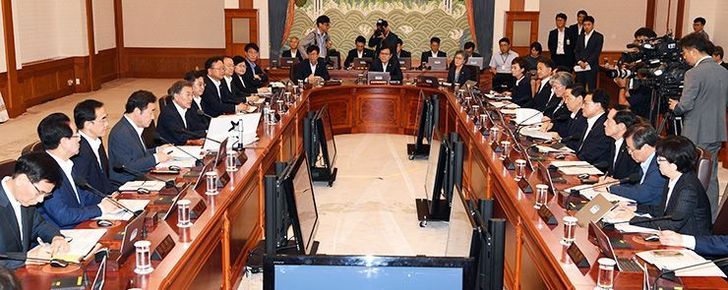
President Moon Jae-in, fifth from left, speaks during a Cabinet meeting at Cheong Wa Dae, Tuesday. This was the first meeting where all participating ministers were newly appointed by the President. Prior to this, some ministers appointed by Moon’s predecessor Park Geun-hye participated as the new administration’s personnel appointments had not been finished. / Korea Times photo by Koh Young-kwon
Government pledges measures to boost workers income
By Yoon Ja-young
Increasing household income and creating more jobs will be two pillars of the government’s policy to promote economic growth. Also, it will support small- and medium-sized enterprises (SMEs) to rise as major economic players, and promote domestic consumption’s contribution to growth.
The Moon Jae-in administration announced these key economic policy directives Tuesday.
“The quantitative growth strategies of the past are not valid anymore,” Strategy and Finance Minister Kim Dong-yeon said. “The economy needs a paradigm shift, and the starting point of economic policy should be people.”
He suggested income-led growth, a job-focused economy, innovative growth and a fair economy as the four principles of the economic policies of the Moon government.
Instead of quantitative growth, the administration aims at forming a virtuous circle of distribution and growth. This starts with increasing households’ disposable income.
The administration made it clear that it would attain its target of 10,000 won ($8.96) as the minimum wage. As the hike could be burdensome for small businesses and merchants hiring low-wage workers, the government plans to temporarily provide subsidies.
On top of raising nominal income, the administration plans to cut living expenses such as housing, telecommunication and transportation costs to pull up real income. This includes supplying 170,000 public rental homes annually and expanding public Wi-Fi.
It will provide 100,000 won in child allowances each month while raising the basic pension for senior citizens. Employment insurance subscriptions will expand to all workers and the unemployed will get more unemployment benefits than now so that they can concentrate on seeking new jobs.
Budget, tax and investment incentives by the government will also focus on job creation. Businesses that increase jobs following facility investment or business expansion will get tax deductions. Those switching irregular jobs to regular ones will get corporate tax cuts.
To tackle youth unemployment, state-run enterprises will be obligated to hire more young adults, while SMEs will get subsidies for hiring them.
Expansionary budget spending
The government said it will expand its budget spending over the next five years, maintaining the growth rate of the budget higher than that for GDP.
It said it will raise revenue by increasing the tax rates on top conglomerates and super-rich individuals.
The administration will also seek a paradigm shift in the economy by making it fairer. It will block conglomerate owner families from exercising too much power on the management of their groups, while introducing an electronic voting system to enhance small shareholders’ rights. Class action lawsuits are also in the works as a move to root out collusion.
A presidential committee on the Fourth Industrial Revolution will be established next month to come up with preparation measures for this within the third quarter.
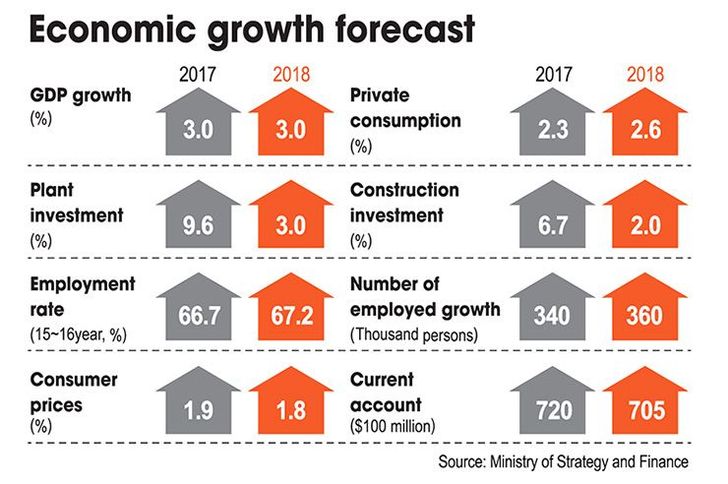
The finance ministry has raised its outlook for economic growth this year to 3 percent from previous estimate of 2.6 percent, on the improving global economy and the 11 trillion won supplementary budget aimed at increasing jobs.
Deputy finance minister Lee Chan-woo said Korea’s growth potential stands at around 3 percent.
“We believe 3 percent growth is attainable by improving productivity through income-led growth and innovation,” he said.
The country’s economy has failed to achieve 3 percent economic growth since 2014 when it grew 3.3 percent.
Around 340,000 jobs are expected to be created, while consumer prices will rise 1.9 percent.
The government, however, cited protectionism in global trade and U.S. key rate hikes as potential threats to the economy.
To minimize the risk posed by the 1,400 trillion won in household debt, the government plans to toughen mortgage regulations including incrementally increasing the debt-to-income and debt service ratios.