Crony capitalism could disappear
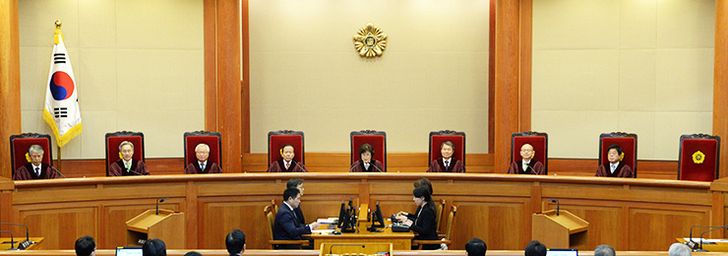
Constitutional Court’s acting President Lee Jung-mi, center, and other justices deliver a ruling on the impeachment of President Park Geun-hye to remove her from office, Friday, at the court in Seoul. / Joint Press Corps
By Yoon Ja-young
The impeachment verdict on former President Park Geun-hye is likely to be an opportunity for Korea to sever the corrupt ties between politics and businesses, market watchers said Friday.
“History doesn’t make progress in just one moment, but I think this will be the start of an irreversible change,” said Kim Sang-jo, a professor of economics at Hansung University.
The Constitutional Court ruled that former President Park infringed upon the Constitution and other laws by abusing her status and power for the interests of her long-time friend Choi Soon-sil. The country’s 53 leading companies provided 77.4 billion won in funding for two foundations controlled by Choi. This included 20.4 billion won “donated” by Samsung Group, Hyundai Motor Group’s 12.8 billion won and SK Group’s 7.8 billion won. The independent counsel team investigating the scandal regarded the donations as bribes from the conglomerates which were seeking business favors in return.
A former executive of a leading conglomerate expected a change in business practices. “It was customary for the political circle to pressure conglomerates to make donations for diverse projects, but the special prosecution deemed it as bribery. It might work as an opportunity for the business circle to get rid of such practice.”
Prof. Kim pointed out that the corrupt ties between politics and business stem not only from the abuse of power by those in the administration but also from the intrinsic problems at the chaebol themselves.
“There was a hole in the conglomerates’ decision-making process, which made them succumb to outside pressure,” Prof. Kim said.
He said that reform within conglomerates is more effective than political reform to sever the corrupt ties, since corporate reform would be irreversible once it starts.
The country’s major conglomerates came up with reform plans, with critics pointing out that their internal control such as boards of directors didn’t function at all when they donated the 77.4 billion won.
Following the arrest of Samsung Electronics Vice Chairman Lee Jae-yong, Samsung Group’s de facto leader, the country’s top conglomerate changed company rules. Any donations or sponsorship exceeding 1 billion won now has to be approved by a board of directors first. Samsung also dismantled its Future Strategy Office, the group’s control tower which was in charge of handling affairs related to the government and political circle.
SK Hynix and SK Telecom also changed their rules, making it obligatory to get the board’s approval first for any donation exceeding 1 billion won.
The Federation of Korean Industries (FKI), the chaebol lobby group which turned out to have worked as a channel for Cheong Wa Dae to collect money from conglomerates, also announced plans to reform itself.
Prof. Kim said it would provide momentum for efforts to improve corporate governance structures and get rid of crony capitalism.
“The country witnessed that setting up well-functioning internal control systems and improving corporate governance structures are the keys to sever corrupt ties. These are essential in making the country’s businesses more productive, effective and respectable.”
He said that the public’s awareness of such needs and the businesses’ recognition that they cannot avoid changes will provide important momentum for the country.