Growth imbalance destabilizes economy
Construction booms, investment dips
By Kim Jae-kyoung
The Korean economy has become less resilient to negative shocks as a result of the government’s policies focusing too much on an easy source of growth, namely the construction sector through low interest rates and debt.
Over the past quarters, the growth imbalance has been deepening with GDP expansion driven mainly by real estate development, which analysts believe will hurt economic resilience and undermine the country’s growth potential in the long term.
This will make it much harder for Asia’s fourth-largest economy to bounce back in the coming years even when other parts of the world enjoy a fast recovery.
In particular, the overheated housing market supported by soaring household debt will put a dent in the economy when the market loses steam due to the hangover of oversupply.
“As financial resources have been misallocated to the less-productive housing sector, we believe Korea’s potential GDP growth will slow at a faster pace in the years ahead,” Nomura economist Kwon Young-sun said in his latest report on Korea.
“A large number of housing units are already under construction. We believe that pent-up demand has been largely saturated in the last two years and therefore oversupply in the primary housing market will likely emerge in 2018.”
According to Nomura, construction work completion in real terms increased by 21.7 percent year-on-year between July and August, up from 19.2 percent in the second quarter.
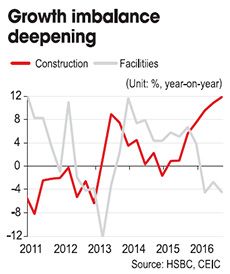
Spurred by the housing market-driven policy, the construction sector continued to become the lone driver for Korea’s growth, while facilities investment and exports remained sluggish.
Construction investment soared by 11.9 percent in the third quarter from a year ago, while facilities investment contracted 4.5 percent. Exports grew only 2.9 percent during the same period.
“Construction investment (in the third quarter) saves the day, helped a bit by government spending,” HSBC said in its latest research note.
The global bank pointed out that growth was narrowly based on construction investment, driven by elevated household debt, and government consumption owing to the supplementary budget.
However, this kind of unhealthy growth won’t be sustainable from two aspects.
First, income is not rising as fast as debt and real estate prices, while a lot of Korean households are already overleveraged.
According to the Financial Supervisory Service, the growth rate for household debt stood at 11.9 percent in the second quarter of this year, well above the income growth rate of 0.9 percent. As a result, the ratio of household debt to disposable income jumped to 173.6 percent in June.
The sales price of apartments in Seoul grew 0.3 percent the last week of September, the fastest weekly rise in 10 years. Translating it into annual terms, it is estimated at around 19 percent.
“South Korean incomes should grow as much as the real estate prices. Otherwise, the assets are really debt, and you eventually get a bubble” said Mauro Guillen, a professor of the Wharton School at the University of Pennsylvania.
Second, Korea’s population is set on a downward course in the long-term due to a low birthrate.
According to Statistics Korea, about 33,900 babies were born in August, down 3.7 percent from 35,200 a year earlier, extending the losing streak to nine straight months since December last year
“Korea’s population is not going to grow any time soon so it seems difficult to sustain a healthy growth of real estate prices, especially given the high household leverage,” Garcia Herrero Alicia, chief economist of Natixis Asia Pacific said.
Moody’s Analytics economist Emily Dabbs said that a sudden rise in the debt servicing burden from higher unemployment or increased mortgage rates could result in a much stronger downturn.
“The biggest risk to longer-term growth is unfavorable demographics and high private debt, which would be exacerbated by a sharp downturn in the housing market.”
Experts said that Korea should not rely too much on the real estate sector just to improve short-term growth figures, calling for policymakers to come up with measures to develop more productive growth sources.
“I think Korea should not risk focusing too much of what so far has been an easy source of growth, namely the real estate sector,” Alicia of Natixis said.
“It is not only Japan that has gone through that pain but also Spain and, arguably China,” she added. “Korea needs to become more productive and innovative. Real estate cannot help.”
Kwon of Nomura said that the government needs a combination of tighter household debt and a looser monetary policy to address the growth imbalance, expecting an additional 50 basis point rate cuts ― one in 2016 and another in March 2017.