New KRX head vows to push for holding firm
By Nam Hyun-woo
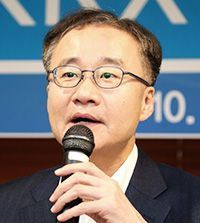
Jeong Chan-woo
Jeong Chan-woo, the new CEO of Korea Exchange (KRX), said Tuesday that the bourse operator will pursue its transformation into a holding firm as its top priority as well as exerting efforts to break the so-called “Boxpi,” an innuendo referring to the narrow movement of the benchmark KOSPI within a box.
“The passage of the revised Capital Market Act will be the KRX’s top management priority,” said Jeong during a press meeting on Yeouido, southern Seoul. “The KRX will make preparations so that it can transform into a holding company as soon as the revision passes and it can be listed through an initial public offering.”
The event was Jeong’s first press meeting as head of Korea’s bourse operator, giving him a chance to showcase his proposed policies. Jeong took the post about three weeks ago, replacing Choi Kyung-soo.
Transforming into a holding firm has been the KRX’s long-cherished plan. The government and the exchange have been pushing forward the plan since the tenure of former chief Choi in a belief that it is the most effective way to diversify its business and raise profits. However, the act, containing legal grounds of the transformation, failed to pass in the previous 19th National Assembly.
“On Nov. 10, the Assembly’s National Policy Committee will make decisions on the revision,” he said. “I will do my utmost for the passage as if the day is my last chance.”
He also stressed that breaking the Boxpi is one of his tasks. For more than five years, the benchmark has been lingering between 1,800 and 2,100, casting woes that the local capital market has lost its vitality.
“In order to achieve the KRX’s goal to become one of the world’s top 10 exchanges, breaking the Boxpi is crucial,” he said. “To do so, the KRX will improve its listing regulations and market infrastructure so that more foreign firms and investors will make investments in the Korean market.”
An official at the KRX said that raising the local stock market’s attractiveness to foreign investors is critical. In part of efforts for that, improving regulations on dividends may come.
Over the calls over revising filing regulations, which came after a stock market stir stemming from Hanmi Pharmaceutical’s belated posting and unfair trading suspicions, Choi said that the KRX will stick to its current regulations.
“The KRX has sent relevant data to the prosecution and is now looking into unfair trading suspicion,” Choi said. “There are calls that the KRX may consider changing regulations so that more company events can be subjects to mandatory filing, however the KRX will go as it is.”
Hanmi caused a stock market stir at the end of last month after the drug maker posted both favorable and unfavorable announcements within two days. On Sept. 29, the company posted news of a big drug deal after the day’s session. The company’s shares soared as soon as the following session opened, but quickly plunged when the company announced the termination of an 850 billion won drug cancer license just 30 minutes after the opening.
The problem was the company was aware of the termination on Sept. 29, but belatedly posted it during the following session. During the 30-minute period, a massive volume of short-selling was conducted, causing losses to individual investors and raising suspicions on unfair trading.
Controversy has been mounting because filing rules state that such technology license deals are not subject to mandatory filing, which forces companies to make postings within the day that an event occurred. Instead, companies can delay such postings until the next day, freeing Hanmi from being responsible for belated posting.
However, Jeong said the bourse operator has to be “prudent” in changing regulations, because mandatory filing will place excessive burdens on companies.